Advertisements
Advertisements
Question
In a parallelogram ABCD, AB = 10 cm, AD = 6 cm. The bisector of ∠A meets DC in E, AEand BC produced meet at F. Find te length CF.
Advertisements
Solution
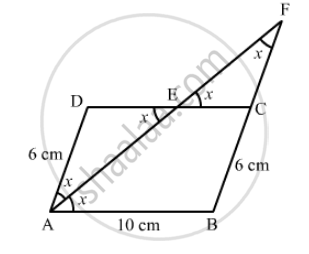
\[\text{ AE is the bisector of } \angle A . \]
\[ \therefore \angle DAE = \angle BAE = x\]
\[ \angle BAE = \angle AED = x (\text{ alternate angles })\]
\[\text{ Since opposite angles in ∆ ADE are equal, ∆ ADE is an isosceles triangle } . \]
\[ \therefore AD = DE = 6 cm (\text{ sides opposite to equal angles })\]
\[AB = CD = 10 cm \]
\[CD = DE + EC\]
\[ \Rightarrow EC = CD - DE\]
\[ \Rightarrow EC = 10 - 6 = 4 cm\]
\[\angle DEA = \angle CEF = x (\text{ vertically opposite angle })\]
\[\angle EAD = \angle EFC = x (\text{ alternate angles })\]
\[\text{ Since opposite angles in } ∆ EFC \text{ are equal, ∆ EFC is an isosceles triangle } . \]
\[ \therefore CF = CE = 4 \text{ cm (sides opposite to equal angles })\]
\[ \therefore CF = 4\text{ cm }\]
RELATED QUESTIONS
All the angles of a quadrilateral are equal to each other. Find the measure of each. Is the quadrilateral a parallelogram? What special type of parallelogram is it?
The perimeter of a parallelogram is 150 cm. One of its sides is greater than the other by 25 cm. Find the length of the sides of the parallelogram.
Which of the following statement is true for a rhombus?
It has two pairs of equal sides.
Which of the following statement is true for a rhombus?
Its diagonals are equal and perpendicular.
Fill in the blank, inthe following, so as to make the statement true:
A rhombus has all its sides of ...... length.
Draw a rhombus, having each side of length 3.5 cm and one of the angles as 40°.
One side of a rhombus is of length 4 cm and the length of an altitude is 3.2 cm. Draw the rhombus.
ABCD is a rhombus whose diagonals intersect at O. If AB = 10 cm, diagonal BD = 16 cm, find the length of diagonal AC.
Which of the following statement is true for a rectangle?
Its diagonals are equal and bisect each other.
If all sides of a quadrilateral are equal, it is a ______.
