Advertisements
Advertisements
प्रश्न
In a parallelogram ABCD, AB = 10 cm, AD = 6 cm. The bisector of ∠A meets DC in E, AEand BC produced meet at F. Find te length CF.
Advertisements
उत्तर
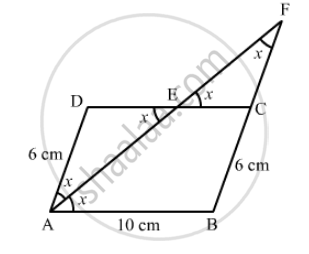
\[\text{ AE is the bisector of } \angle A . \]
\[ \therefore \angle DAE = \angle BAE = x\]
\[ \angle BAE = \angle AED = x (\text{ alternate angles })\]
\[\text{ Since opposite angles in ∆ ADE are equal, ∆ ADE is an isosceles triangle } . \]
\[ \therefore AD = DE = 6 cm (\text{ sides opposite to equal angles })\]
\[AB = CD = 10 cm \]
\[CD = DE + EC\]
\[ \Rightarrow EC = CD - DE\]
\[ \Rightarrow EC = 10 - 6 = 4 cm\]
\[\angle DEA = \angle CEF = x (\text{ vertically opposite angle })\]
\[\angle EAD = \angle EFC = x (\text{ alternate angles })\]
\[\text{ Since opposite angles in } ∆ EFC \text{ are equal, ∆ EFC is an isosceles triangle } . \]
\[ \therefore CF = CE = 4 \text{ cm (sides opposite to equal angles })\]
\[ \therefore CF = 4\text{ cm }\]
संबंधित प्रश्न
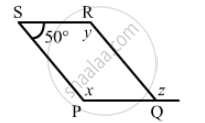
The following figure is parallelogram. Find the degree values of the unknown x, y, z.
Fill in the blank, inthe following, so as to make the statement true:
A rhombus has all its sides of ...... length.
One side of a rhombus is of length 4 cm and the length of an altitude is 3.2 cm. Draw the rhombus.
Show that each diagonal of a rhombus bisects the angle through which it passes.
The diagonals of a quadrilateral are of lengths 6 cm and 8 cm. If the diagonals bisect each other at right angles, what is the length of each side of the quadrilateral?
Which of the following statement is true for a rectangle?
Its diagonals are equal and bisect each other.
State with reason whether the following statement is ‘true’ or ‘false’.
Every rhombus is a rectangle.
ABCD is a rhombus. If ∠BCA = 35°. find ∠ADC.
If a diagonal of a quadrilateral bisects both the angles, then it is a ______.
ABCD is a rhombus such that the perpendicular bisector of AB passes through D. Find the angles of the rhombus.
Hint: Join BD. Then ∆ABD is equilateral.
