Advertisements
Advertisements
प्रश्न
Diagonals of a quadrilateral are perpendicular to each other. Is such a quadrilateral always a rhombus? Give a figure to justify your answer.
Advertisements
उत्तर
It is not necessary that a quadrilateral having perpendicular diagonals is a rhombus.
E.g. Consider a trapezium ABCD in which AB || CD.
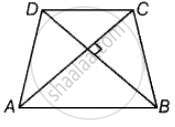
APPEARS IN
संबंधित प्रश्न
The measure of one angle of a parallelogram is 70°. What are the measures of the remaining angles?
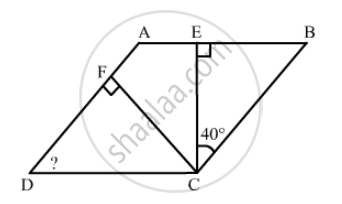
Find the angles marked with a question mark shown in Fig. 17.27
Fill in the blank, in the following, so as to make the statement true:
A rhombus is a parallelogram in which ......
Construct a rhombus whose diagonals are of length 10 cm and 6 cm.
Show that each diagonal of a rhombus bisects the angle through which it passes.
Diagonals of a rhombus are 20 cm and 21 cm respectively, then find the side of rhombus and its perimeter.
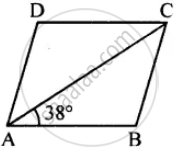
ABCD is a rhombus. If ∠BAC = 38°, find :
(i) ∠ACB
(ii) ∠DAC
(iii) ∠ADC.
The lengths of the diagonals of a Rhombus are 12 cm and 16 cm. Find the side of the rhombus
If the adjacent sides of a parallelogram are equal then parallelogram is a ______.
If a diagonal of a quadrilateral bisects both the angles, then it is a ______.
