Advertisements
Advertisements
प्रश्न
ABCD is a parallelogram in which ∠A = 70°. Compute ∠B, ∠C and ∠D.
Advertisements
उत्तर
\[\text{ Opposite angles of a parallelogram are equal } . \]
\[ \therefore \angle C = 70° = \angle A . \]
\[ \angle B = \angle D\]
\[\text{ Also, the sum of the adjacent angles of a parallelogram is } 180°. \]
\[ \therefore \angle A + \angle B = 180°\]
\[70° + \angle B = 180°\]
\[\angle B = 110°\]
\[ \therefore \angle B = 110°, \angle C = 70°\text{ and } \angle D = 110°\]
संबंधित प्रश्न
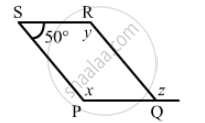
The following figure is parallelogram. Find the degree values of the unknown x, y, z.
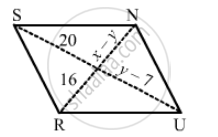
In the following figure GUNS and RUNS are parallelogram. Find x and y.
Two adjacent sides of a parallelogram are 4 cm and 3 cm respectively. Find its perimeter.
Which of the following statement is true for a rhombus?
Two of its angles are at right angles
Fill in the blank, in each of the following, so as to make the statement true:
If the diagonals of a parallelogram bisect each other at right angles, then it is a ......
ABCD is a rhombus. If ∠ACB = 40°, find ∠ADB.
Construct a rhombus whose diagonals are of length 10 cm and 6 cm.
Diagonals PR and QS of a rhombus PQRS are 20 cm and 48 cm respectively. Find the length of side PQ.
In rhombus ABCD;
(i) if ∠A = 74° ; find ∠B and ∠C.
(ii) if AD = 7.5 cm ; find BC and CD.
A rhombus is a parallelogram in which ______ sides are equal.
