Advertisements
Advertisements
प्रश्न
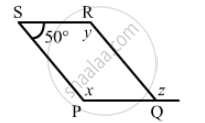
The following figure is parallelogram. Find the degree values of the unknown x, y, z.
Advertisements
उत्तर
\[\text{ Opposite angles of a parallelogram are same } . \]
\[ \therefore x = y \text{ and } \angle RQP = 100°\]
\[\angle PSR + \angle SRQ = 180°\]
\[y + 50°= 180°\]
\[x = 180°- 50°\]
\[x = 130°\]
\[ \therefore x = 130°, y = 130° \]
\[ \text{ Since y and z are alternate angles, z }= 130° . \]
संबंधित प्रश्न
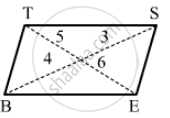
Can the following figure be parallelogram. Justify your answer.
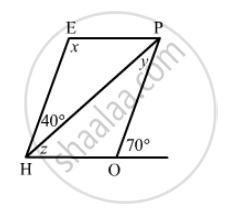
In the adjacent figure HOPE is a parallelogram. Find the angle measures x,y and z. State the geometrical truths you use to find them.
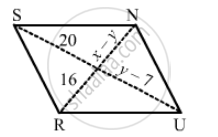
In the following figure GUNS and RUNS are parallelogram. Find x and y.
The sum of two opposite angles of a parallelogram is 130°. Find all the angles of the parallelogram.
Two adjacent sides of a parallelogram are 4 cm and 3 cm respectively. Find its perimeter.
In a parallelogram ABCD, AB = 10 cm, AD = 6 cm. The bisector of ∠A meets DC in E, AEand BC produced meet at F. Find te length CF.
Which of the following statement is true for a rhombus?
Two of its angles are at right angles
Which of the following statement is true for a rhombus?
It is a quadrilateral.
Which of the following statement is true for a rhombus?
It can be a square.
ABCD is a rhombus. If ∠BCA = 35°. find ∠ADC.
