Advertisements
Advertisements
प्रश्न
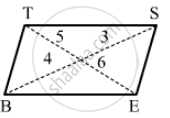
Can the following figure be parallelogram. Justify your answer.
Advertisements
उत्तर
\[\text{ No, This is because the diagonals do not bisect each other } .\]
संबंधित प्रश्न
All rhombuses are parallelograms.
If an angle of a parallelogram is two-third of its adjacent angle, find the angles of the parallelogram.
ABCD is a parallelogram in which ∠A = 70°. Compute ∠B, ∠C and ∠D.
Points E and F lie on diagonal AC of a parallelogram ABCD such that AE = CF. What type of quadrilateral is BFDE?
Which of the following statement is true for a rhombus?
It is a square.
Fill in the blank, in the following, so as to make the statement true:
The diagonals of a rhombus ...... each other at ...... angles.
Diagonals PR and QS of a rhombus PQRS are 20 cm and 48 cm respectively. Find the length of side PQ.
ABCD is a rhombus. If ∠BCA = 35°. find ∠ADC.
In a rhombus diagonals intersect at ______ angles.
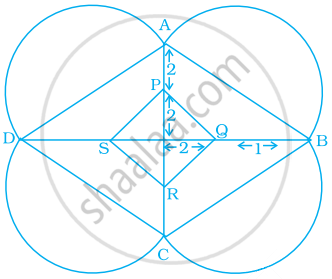
A Rangoli has been drawn on a flor of a house. ABCD and PQRS both are in the shape of a rhombus. Find the radius of semicircle drawn on each side of rhombus ABCD.