Advertisements
Advertisements
प्रश्न
The diagonals of a parallelogram are not perpendicular. Is it a rhombus? Why or why not?
Advertisements
उत्तर
No, it is not a rhombus. This is because diagonals of a rhombus must be perpendicular.
संबंधित प्रश्न
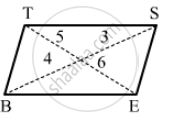
Can the following figure be parallelogram. Justify your answer.
ABCD is a parallelogram in which ∠A = 70°. Compute ∠B, ∠C and ∠D.
All the angles of a quadrilateral are equal to each other. Find the measure of each. Is the quadrilateral a parallelogram? What special type of parallelogram is it?
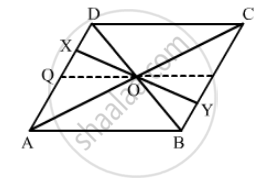
Diagonals of parallelogram ABCD intersect at O as shown in the following fegure. XY contains O, and X, Y are points on opposite sides of the parallelogram. Give reasons for each of the following:
(i) OB = OD
(ii) ∠OBY = ∠ODX
(iii) ∠BOY = ∠DOX
(iv) ∆BOY ≅ ∆DOX
Now, state if XY is bisected at O.
Which of the following statement is true for a rhombus?
Its diagonals bisect each other at right angles.
Which of the following statement is true for a rhombus?
It is a parallelogram.
A quadrilateral whose all sides are equal, opposite angles are equal and the diagonals bisect each other at right angles is a ______.
If the adjacent sides of a parallelogram are equal then parallelogram is a ______.
In a rhombus diagonals intersect at ______ angles.
ABCD is a rhombus such that the perpendicular bisector of AB passes through D. Find the angles of the rhombus.
Hint: Join BD. Then ∆ABD is equilateral.
