Advertisements
Advertisements
Question
The diagonals of a parallelogram are not perpendicular. Is it a rhombus? Why or why not?
Advertisements
Solution
No, it is not a rhombus. This is because diagonals of a rhombus must be perpendicular.
RELATED QUESTIONS
The following figure is parallelogram. Find the degree values of the unknowns x, y, z.
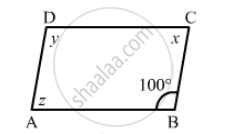
Can the following figure be parallelogram. Justify your answer.
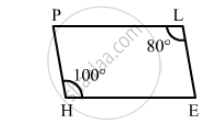
Can the following figure be parallelogram. Justify your answer.
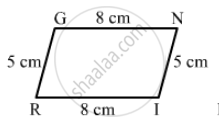
In the following figure GUNS and RUNS are parallelogram. Find x and y.
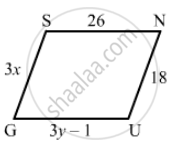
All the angles of a quadrilateral are equal to each other. Find the measure of each. Is the quadrilateral a parallelogram? What special type of parallelogram is it?
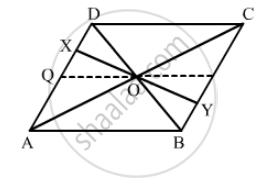
Diagonals of parallelogram ABCD intersect at O as shown in the following fegure. XY contains O, and X, Y are points on opposite sides of the parallelogram. Give reasons for each of the following:
(i) OB = OD
(ii) ∠OBY = ∠ODX
(iii) ∠BOY = ∠DOX
(iv) ∆BOY ≅ ∆DOX
Now, state if XY is bisected at O.
Fill in the blank, in the following, so as to make the statement true:
The diagonals of a rhombus ...... each other at ...... angles.
Draw a rhombus, having each side of length 3.5 cm and one of the angles as 40°.
Show that each diagonal of a rhombus bisects the angle through which it passes.
A rhombus is a parallelogram in which ______ sides are equal.
