Advertisements
Advertisements
Question
In the following Figure ABCD is a arallelogram, CE bisects ∠C and AF bisects ∠A. In each of the following, if the statement is true, give a reason for the same:
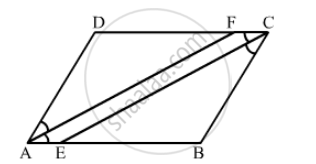
(i) ∠A = ∠C
(ii) \[\angle FAB = \frac{1}{2}\angle A\]
(iii) \[\angle DCE = \frac{1}{2}\angle C\]
(iv) \[\angle CEB = \angle FAB\]
(v) CE || AF
Advertisements
Solution
(i) True, since opposite angles of a parallelogram are equal.
(ii) True, as AF is the bisector of\[\angle\] A.
(iii) True, as CE is the bisector of \[\angle\]C.
(iv) True
\[\angle\]CEB =\[\angle\] DCE........(i) (alternate angles)
\[\angle\]DCE= \[\angle\] FAB.........(ii) (opposite angles of a parallelogram are equal)
From equations (i) and (ii):
\[\angle\] CEB =\[\angle\]FAB
(v) True, as corresponding angles are equal (\[\angle\] CEB =\[\angle\] FAB).
RELATED QUESTIONS
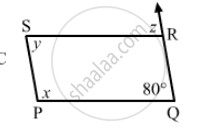
The following figure is parallelogram. Find the degree values of the unknown x, y, z.
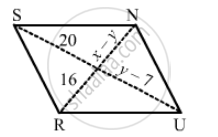
In the following figure GUNS and RUNS are parallelogram. Find x and y.
ABCD is a parallelogram in which ∠A = 70°. Compute ∠B, ∠C and ∠D.
Which of the following statement is true for a rhombus?
It has two pairs of equal sides.
Which of the following statement is true for a rhombus?
It has all its sides of equal lengths.
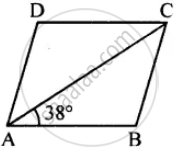
ABCD is a rhombus. If ∠BAC = 38°, find :
(i) ∠ACB
(ii) ∠DAC
(iii) ∠ADC.
ABCD is a rhombus. If ∠BCA = 35°. find ∠ADC.
If the adjacent sides of a parallelogram are equal then parallelogram is a ______.
If all sides of a quadrilateral are equal, it is a ______.
ABCD is a rhombus such that the perpendicular bisector of AB passes through D. Find the angles of the rhombus.
Hint: Join BD. Then ∆ABD is equilateral.
