Advertisements
Advertisements
Question
Construct a rhombus whose side is 5 cm and one angle is of 60°.
Advertisements
Solution
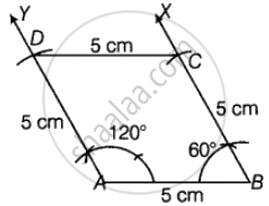
Suppose ∠B = 60°
∠A + ∠B = 180° ...[Sum of cointerior angles]
∠A + 60° = 180°
∠A = 120°
AB = BC = CD = DA = 5 cm
Steps of construction:
Step I: Draw AB = 5 cm.
Step II: Draw a ray AY that is ∠BAY = 120°.
Step III: Mark a point D that is AD = 5 cm.
Step IV: Draw a ray BX that is ∠ABX = 60°.
Step V: Mark a point C that is BC = 5 cm.
Step VI: Join C and D.
Hence, ABCD is the required rhombus.
APPEARS IN
RELATED QUESTIONS
All rhombuses are parallelograms.
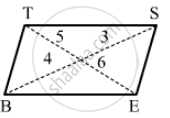
Can the following figure be parallelogram. Justify your answer.
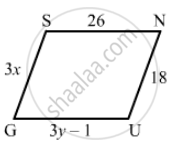
In the following figure GUNS and RUNS are parallelogram. Find x and y.
Two adjacent angles of a parallelogram are as 1 : 2. Find the measures of all the angles of the parallelogram.
Which of the following statement is true for a rhombus?
It is a quadrilateral.
Fill in the blank, in the following, so as to make the statement true:
A rhombus is a parallelogram in which ......
The diagonals of a parallelogram are not perpendicular. Is it a rhombus? Why or why not?
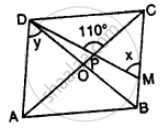
The given figure shows a rhombus ABCD in which angle BCD = 80°. Find angles x and y.
If the adjacent sides of a parallelogram are equal then parallelogram is a ______.
ABCD is a rhombus such that the perpendicular bisector of AB passes through D. Find the angles of the rhombus.
Hint: Join BD. Then ∆ABD is equilateral.
