Advertisements
Advertisements
Question
Construct a rectangle whose one side is 3 cm and a diagonal equal to 5 cm.
Advertisements
Solution
We know that, diagonals of a rectangle and opposite sides are equal.
All the angles of rectangle are right angle.
So, AC = 5 cm
AB = 3 cm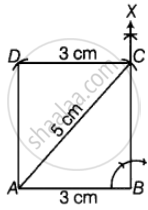
Steps of construction:
Step I: Draw AB = 3 cm.
Step II: Draw a ray BX such that ∠ABX = 90°.
Step III: Draw an arc such that AC = 5 cm.
Step IV: With B as centre, draw an arc of radius 5 cm. With C as centre, draw another arc of radius 3 cm which intersect first arc at a point, suppose D.
Step V: Join CD and AD.
Hence, ABCD is the required rectangle.
APPEARS IN
RELATED QUESTIONS
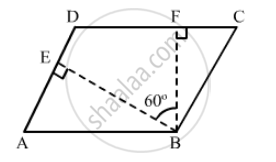
The angle between the altitudes of a parallelogram, through the same vertex of an obtuse angle of the parallelogram is 60°. Find the angles of the parallelogram.
In Fig. 17.29, suppose it is known that DE = DF. Then, is ΔABC isosceles? Why or why not?
Which of the following statement is true for a rectangle?
Its diagonals are perpendicular.
Fill in the blank in the following, so as to make the statement true:
A square is a rhombus in which .....
State with Reason Whether the Following Statement is ‘True’ Or ‘False’.
Every rectangle is a parallelogram.
Diagonals of a rectangle PQRS are intersecting in point M. If ∠QMR = 50° find the measure of ∠MPS.
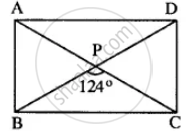
ABCD is a rectangle, if ∠BPC = 124°
Calculate:
- ∠BAP
- ∠ADP
ABCD is a rectangle whose diagonals AC and BD intersect at O. If ∠OAB = 46°, find ∠OBC
Every parallelogram is a rectangle.
A rectangular MORE is shown below:

Answer the following questions by giving appropriate reason.
- Is RE = OM?
- Is ∠MYO = ∠RXE?
- Is ∠MOY = ∠REX?
- Is ΔMYO ≅ ΔRXE?
- Is MY = RX?
