Advertisements
Advertisements
प्रश्न
Construct a rectangle whose one side is 3 cm and a diagonal equal to 5 cm.
Advertisements
उत्तर
We know that, diagonals of a rectangle and opposite sides are equal.
All the angles of rectangle are right angle.
So, AC = 5 cm
AB = 3 cm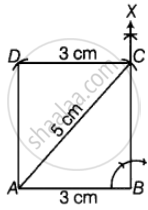
Steps of construction:
Step I: Draw AB = 3 cm.
Step II: Draw a ray BX such that ∠ABX = 90°.
Step III: Draw an arc such that AC = 5 cm.
Step IV: With B as centre, draw an arc of radius 5 cm. With C as centre, draw another arc of radius 3 cm which intersect first arc at a point, suppose D.
Step V: Join CD and AD.
Hence, ABCD is the required rectangle.
APPEARS IN
संबंधित प्रश्न
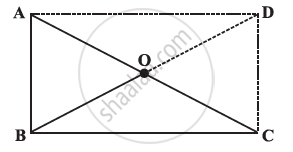
ABC is a right-angled triangle and O is the mid point of the side opposite to the right angle. Explain why O is equidistant from A, B and C. (The dotted lines are drawn additionally to help you)
In a parallelogram ABCD, the diagonals bisect each other at O. If ∠ABC = 30°, ∠BDC = 10° and ∠CAB = 70°. Find:
∠DAB, ∠ADC, ∠BCD, ∠AOD, ∠DOC, ∠BOC, ∠AOB, ∠ACD, ∠CAB, ∠ADB, ∠ACB, ∠DBC and ∠DBA.
In Fig. 17.29, suppose it is known that DE = DF. Then, is ΔABC isosceles? Why or why not?
Which of the following statement is true for a square?
It is a rectangle.
Which of the following statement true for a square?
Its diagonals bisect each other at right angle.
A mason has made a concrete slab. He needs it to be rectangular. In what different ways can he make sure that it is rectangular?
State with Reason Whether the Following Statement is ‘True’ Or ‘False’.
Every rectangle is a parallelogram.
Every parallelogram is a rectangle.
Every trapezium is a rectangle.
PQRS is a rectangle. The perpendicular ST from S on PR divides ∠S in the ratio 2:3. Find ∠TPQ.
