Advertisements
Advertisements
प्रश्न
Construct a rectangle whose one side is 3 cm and a diagonal equal to 5 cm.
Advertisements
उत्तर
We know that, diagonals of a rectangle and opposite sides are equal.
All the angles of rectangle are right angle.
So, AC = 5 cm
AB = 3 cm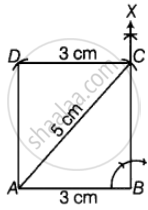
Steps of construction:
Step I: Draw AB = 3 cm.
Step II: Draw a ray BX such that ∠ABX = 90°.
Step III: Draw an arc such that AC = 5 cm.
Step IV: With B as centre, draw an arc of radius 5 cm. With C as centre, draw another arc of radius 3 cm which intersect first arc at a point, suppose D.
Step V: Join CD and AD.
Hence, ABCD is the required rectangle.
APPEARS IN
संबंधित प्रश्न
Name the quadrilaterals whose diagonals are equal
Diagonals of a parallelogram ABCD intersect at O. AL and CM are drawn perpendiculars to BD such that L and M lie on BD. Is AL = CM? Why or why not?
Draw a square whose each side measures 4.8 cm.
Using opposite angles test for parallelogram, prove that every rectangle is a parallelogram.
Adjacent sides of a rectangle are 7 cm and 24 cm. Find the length of its diagonal.
For which of the following figures, diagonals are equal?
If the diagonals of a quadrilateral are equal and bisect each other, then the quadrilateral is a ______.
A parallelogram PQRS is constructed with sides QR = 6 cm, PQ = 4 cm and ∠PQR = 90°. Then PQRS is a ______.
All squares are rectangles.
Rectangle is a regular quadrilateral.
