Advertisements
Advertisements
प्रश्न
Draw a square whose each side measures 4.8 cm.
Advertisements
उत्तर
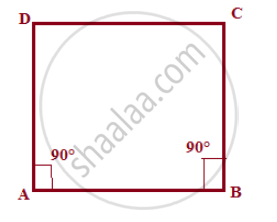
\[\text{ (i) Draw side AB = 4 . 8 cm } . \]
\[\text{ (ii) From A, make an angle of 90°and cut it at 4 . 8 cm and mark it point D } . \]
\[\text{ (iii) From B, make an angle of 90° and cut it at 4 . 8 cm and mark it point C } . \]
\[\text{ (iv) Join C and D } . \]
\[\text{ Thus, ABCD is the required square } .\]
संबंधित प्रश्न
Which of the following statement is true for a rectangle?
Its diagonals are equal.
Which of the following statement is true for a rectangle?
Its diagonals are perpendicular.
Fill in the blank in the following, so as to make the statement true:
A square is a rhombus in which .....
If diagonal of a rectangle is 26 cm and one side is 24 cm, find the other side.
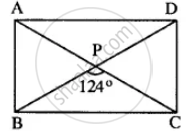
ABCD is a rectangle, if ∠BPC = 124°
Calculate:
- ∠BAP
- ∠ADP
If the diagonals of a parallelogram are of equal lengths, the parallelogram is a rectangle. Prove it.
Rectangle is a regular quadrilateral.
In rectangle READ, find ∠EAR, ∠RAD and ∠ROD

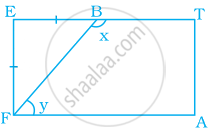
A playground is in the form of a rectangle ATEF. Two players are standing at the points F and B where EF = EB. Find the values of x and y.
Quadrilateral EFGH is a rectangle in which J is the point of intersection of the diagonals. Find the value of x if JF = 8x + 4 and EG = 24x – 8.
