Advertisements
Advertisements
Question
Draw a square whose each side measures 4.8 cm.
Advertisements
Solution
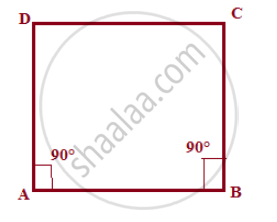
\[\text{ (i) Draw side AB = 4 . 8 cm } . \]
\[\text{ (ii) From A, make an angle of 90°and cut it at 4 . 8 cm and mark it point D } . \]
\[\text{ (iii) From B, make an angle of 90° and cut it at 4 . 8 cm and mark it point C } . \]
\[\text{ (iv) Join C and D } . \]
\[\text{ Thus, ABCD is the required square } .\]
RELATED QUESTIONS
In Fig. 17.29, suppose it is known that DE = DF. Then, is ΔABC isosceles? Why or why not?
Which of the following statement is true for a square?
It is a rectangle.
Which of the following statement true for a square?
Its diagonals bisect each other at right angle.
Which of the following statement true for a square?
Its diagonals are equal to its sides.
The sides of a rectangle are in the ratio 2 : 3, and its perimeter is 20 cm. Draw the rectangle.
Find the length of the diagonal of a rectangle whose sides are 12 cm and 5 cm.
Draw a rectangle ABCD such that l(AB) = 6.0 cm and l (BC) = 4.5 cm.
The following figure is a rectangle in which x: y = 3: 7; find the values of x and y.
Every parallelogram is a rectangle.
A line l is parallel to line m and a transversal p intersects them at X, Y respectively. Bisectors of interior angles at X and Y interesct at P and Q. Is PXQY a rectangle? Given reason.
