Advertisements
Advertisements
Question
Which of the following statement true for a square?
Its diagonals are equal to its sides.
Advertisements
Solution
False
This is because the hypotenuse in any right angle triangle is always greater than its two sides.
RELATED QUESTIONS
The shorter side of a parallelogram is 4.8 cm and the longer side is half as much again as the shorter side. Find the perimeter of the parallelogram.
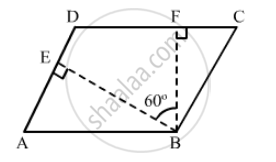
The angle between the altitudes of a parallelogram, through the same vertex of an obtuse angle of the parallelogram is 60°. Find the angles of the parallelogram.
Which of the following statement is true for a square?
It is a rectangle.
Which of the following statement true for a square?
Its diagonals bisect each other at right angle.
The sides of a rectangle are in the ratio 4 : 5. Find its sides if the perimeter is 90 cm.
State with Reason Whether the Following Statement is ‘True’ Or ‘False’.
Every rectangle is a parallelogram.
Draw a rectangle ABCD such that l(AB) = 6.0 cm and l (BC) = 4.5 cm.
Show that the bisectors of angles of a parallelogram form a rectangle
Every parallelogram is a rectangle.
Quadrilateral EFGH is a rectangle in which J is the point of intersection of the diagonals. Find the value of x if JF = 8x + 4 and EG = 24x – 8.
