Advertisements
Advertisements
प्रश्न
Which of the following statement true for a square?
Its diagonals are equal to its sides.
Advertisements
उत्तर
False
This is because the hypotenuse in any right angle triangle is always greater than its two sides.
संबंधित प्रश्न
Name the quadrilaterals whose diagonals are equal
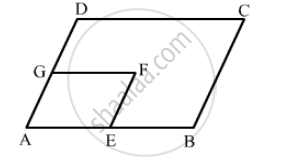
In the following figure, ABCD and AEFG are parallelograms. If ∠C = 55°, what is the measure of ∠F?
Which of the following statement true for a square?
Its diagonals bisect each other at right angle.
In a rectangle ABCD, prove that ∆ACB ≅ ∆CAD.
The sides of a rectangle are in the ratio 4 : 5. Find its sides if the perimeter is 90 cm.
For which of the following figures, diagonals are equal?
If the adjacent angles of a parallelogram are equal, then the parallelogram is a ______.
All squares are rectangles.
In rectangle READ, find ∠EAR, ∠RAD and ∠ROD

Construct a rectangle whose one side is 3 cm and a diagonal equal to 5 cm.
