Advertisements
Advertisements
प्रश्न
In Fig. 17.29, suppose it is known that DE = DF. Then, is ΔABC isosceles? Why or why not?
Advertisements
उत्तर
\[\text{ In } ∆ FDE: \]
\[DE = DF \]
\[ \therefore \angle FED = \angle DFE . . . . . . . . . . . . . (i) (\text{ angles opposite to equal sides })\]
\[\text{ In the } {II}^{gm} BDEF: \]
\[\angle FBD = \angle FED . . . . . . . (ii) (\text{ opposite angles of a parallelogram are equal })\]
\[\text{ In the } {II}^{gm} DCEF: \]
\[\angle DCE = \angle DFE . . . . . . (iii) (\text{ opposite angles of a parallelogram are equal })\]
\[\text{ From equations } (i), (ii) \text{ and } (iii): \]
\[\angle FBD = \angle DCE\]
\[\text{ In } \bigtriangleup ABC: \]
\[If \angle FBD = \angle DCE, \text{ then } AB = AC (\text{ sides opposite to equal angles }) . \]
\[\text{ Hence }, \bigtriangleup ABC \text{ is isosceles }.\]
संबंधित प्रश्न
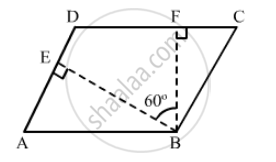
The angle between the altitudes of a parallelogram, through the same vertex of an obtuse angle of the parallelogram is 60°. Find the angles of the parallelogram.
Which of the following statement is true for a rectangle?
Its diagonals are equal.
Which of the following statement are true for a square?
It has all its sides of equal length.
The sides of a rectangle are in the ratio 4 : 5. Find its sides if the perimeter is 90 cm.
Using opposite angles test for parallelogram, prove that every rectangle is a parallelogram.
Diagonals of a rectangle ABCD intersect at point O. If AC = 8 cm then find BO and if ∠CAD =35° then find ∠ACB.
State with Reason Whether the Following Statement is ‘True’ Or ‘False’.
Every rectangle is a parallelogram.
State with reason whether the following statement is ‘true’ or ‘false’.
Every parallelogram is a rectangle.
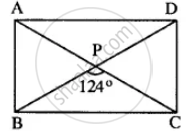
ABCD is a rectangle, if ∠BPC = 124°
Calculate:
- ∠BAP
- ∠ADP
A line l is parallel to line m and a transversal p intersects them at X, Y respectively. Bisectors of interior angles at X and Y interesct at P and Q. Is PXQY a rectangle? Given reason.
