Advertisements
Advertisements
प्रश्न
Which of the following statement true for a square?
Its diagonals bisect each other at right angle.
Advertisements
उत्तर
True
संबंधित प्रश्न
Two adjacent angles of a parallelogram are (3x − 4)° and (3x + 10)°. Find the angles of the parallelogram.
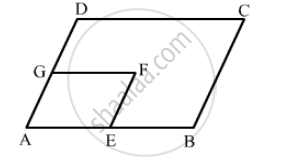
In the following figure, ABCD and AEFG are parallelograms. If ∠C = 55°, what is the measure of ∠F?
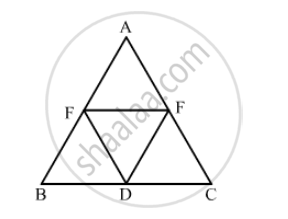
In the following figure, BDEF and DCEF are each a parallelogram. Is it true that BD = DC? Why or why not?
Which of the following statement is true for a rectangle?
It has two pairs of equal sides.
Fill in the blank in the following, so as to make the statement true:
A rectangle is a parallelogram in which .....
Fill in the blank in the following, so as to make the statement true:
A square is a rhombus in which .....
Draw a square whose each side measures 4.8 cm.
A parallelogram PQRS is constructed with sides QR = 6 cm, PQ = 4 cm and ∠PQR = 90°. Then PQRS is a ______.
Every trapezium is a rectangle.
A line l is parallel to line m and a transversal p intersects them at X, Y respectively. Bisectors of interior angles at X and Y interesct at P and Q. Is PXQY a rectangle? Given reason.
