Advertisements
Advertisements
प्रश्न
Two adjacent angles of a parallelogram are (3x − 4)° and (3x + 10)°. Find the angles of the parallelogram.
Advertisements
उत्तर
\[\text{ We know that the adjacent angles of a parallelogram are supplementry } . \]
\[\text{ Hence }, \left( 3x + 10 \right)° \text{ and } \left( 3x - 4 \right)° \text{ are supplementry } . \]
\[\left( 3x + 10 \right)°+ \left( 3x - 4 \right)° = 180°\]
\[6x° + 6°= 180°\]
\[6x° = 174°\]
\[x = 29°\]
\[\text{ First angle } = \left( 3x + 10 \right)°= \left( 3 \times 29° + 10° \right) = 97°\]
\[\text{ Second angle }= \left( 3x - 4 \right)° = 83°\]
\[\text{ Thus, the angles of the parallelogram are } 97°, 83°, 97° \text{ and } 83°.\]
संबंधित प्रश्न
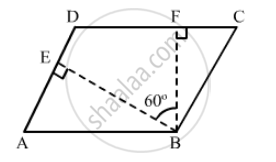
The angle between the altitudes of a parallelogram, through the same vertex of an obtuse angle of the parallelogram is 60°. Find the angles of the parallelogram.
Which of the following statement is true for a rectangle?
It has two pairs of equal sides.
Which of the following statement is true for a rectangle?
Its diagonals are perpendicular.
Prove that quadrilateral formed by the intersection of angle bisectors of all angles of a parallelogram is a rectangle.

Diagonals of a rectangle PQRS are intersecting in point M. If ∠QMR = 50° find the measure of ∠MPS.
Draw a rectangle ABCD such that l(AB) = 6.0 cm and l (BC) = 4.5 cm.
A parallelogram PQRS is constructed with sides QR = 6 cm, PQ = 4 cm and ∠PQR = 90°. Then PQRS is a ______.
In rectangle READ, find ∠EAR, ∠RAD and ∠ROD

A rectangular MORE is shown below:

Answer the following questions by giving appropriate reason.
- Is RE = OM?
- Is ∠MYO = ∠RXE?
- Is ∠MOY = ∠REX?
- Is ΔMYO ≅ ΔRXE?
- Is MY = RX?
Quadrilateral EFGH is a rectangle in which J is the point of intersection of the diagonals. Find the value of x if JF = 8x + 4 and EG = 24x – 8.
