Advertisements
Advertisements
Question
Two adjacent angles of a parallelogram are (3x − 4)° and (3x + 10)°. Find the angles of the parallelogram.
Advertisements
Solution
\[\text{ We know that the adjacent angles of a parallelogram are supplementry } . \]
\[\text{ Hence }, \left( 3x + 10 \right)° \text{ and } \left( 3x - 4 \right)° \text{ are supplementry } . \]
\[\left( 3x + 10 \right)°+ \left( 3x - 4 \right)° = 180°\]
\[6x° + 6°= 180°\]
\[6x° = 174°\]
\[x = 29°\]
\[\text{ First angle } = \left( 3x + 10 \right)°= \left( 3 \times 29° + 10° \right) = 97°\]
\[\text{ Second angle }= \left( 3x - 4 \right)° = 83°\]
\[\text{ Thus, the angles of the parallelogram are } 97°, 83°, 97° \text{ and } 83°.\]
RELATED QUESTIONS
Which of the following statement is true for a rectangle?
Its diagonals bisect each other.
Which of the following statement is true for a rectangle?
All rectangles are squares.
The sides of a rectangle are in the ratio 2 : 3, and its perimeter is 20 cm. Draw the rectangle.
Find the length of the diagonal of a rectangle whose sides are 12 cm and 5 cm.
If the diagonals of a parallelogram are of equal lengths, the parallelogram is a rectangle. Prove it.
All squares are rectangles.
Every parallelogram is a rectangle.
Every rectangle is a trapezium.
PQRS is a rectangle. The perpendicular ST from S on PR divides ∠S in the ratio 2:3. Find ∠TPQ.
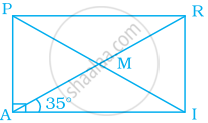
In rectangle PAIR, find ∠ARI, ∠RMI and ∠PMA.