Advertisements
Advertisements
प्रश्न
Two adjacent angles of a parallelogram are (3x − 4)° and (3x + 10)°. Find the angles of the parallelogram.
Advertisements
उत्तर
\[\text{ We know that the adjacent angles of a parallelogram are supplementry } . \]
\[\text{ Hence }, \left( 3x + 10 \right)° \text{ and } \left( 3x - 4 \right)° \text{ are supplementry } . \]
\[\left( 3x + 10 \right)°+ \left( 3x - 4 \right)° = 180°\]
\[6x° + 6°= 180°\]
\[6x° = 174°\]
\[x = 29°\]
\[\text{ First angle } = \left( 3x + 10 \right)°= \left( 3 \times 29° + 10° \right) = 97°\]
\[\text{ Second angle }= \left( 3x - 4 \right)° = 83°\]
\[\text{ Thus, the angles of the parallelogram are } 97°, 83°, 97° \text{ and } 83°.\]
संबंधित प्रश्न
The shorter side of a parallelogram is 4.8 cm and the longer side is half as much again as the shorter side. Find the perimeter of the parallelogram.
In Fig. 17.29, suppose it is known that DE = DF. Then, is ΔABC isosceles? Why or why not?
Which of the following statement is true for a square?
It is a rectangle.
A mason has made a concrete slab. He needs it to be rectangular. In what different ways can he make sure that it is rectangular?
Prove that quadrilateral formed by the intersection of angle bisectors of all angles of a parallelogram is a rectangle.

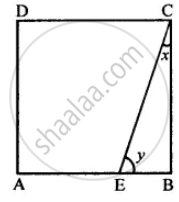
The following figure is a rectangle in which x: y = 3: 7; find the values of x and y.
If the diagonals of a quadrilateral are equal and bisect each other, then the quadrilateral is a ______.
Every rectangle is a trapezium.
PQRS is a rectangle. The perpendicular ST from S on PR divides ∠S in the ratio 2:3. Find ∠TPQ.
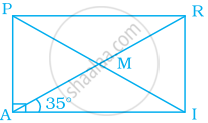
In rectangle PAIR, find ∠ARI, ∠RMI and ∠PMA.