Advertisements
Advertisements
प्रश्न
A rectangular MORE is shown below:

Answer the following questions by giving appropriate reason.
- Is RE = OM?
- Is ∠MYO = ∠RXE?
- Is ∠MOY = ∠REX?
- Is ΔMYO ≅ ΔRXE?
- Is MY = RX?
Advertisements
उत्तर
i. Yes, RE = OM
Given, MORE is a rectangle.
Therefore, opposite sides are equal.
ii. Yes, ∠MYO = ∠RXE
Here, MY and RX are perpendicular to OE.
Since, ∠RXO = 90°
⇒ ∠RXE = 90° and ∠MYE = 90°
⇒ ∠MYO = 90°
iii. Yes, ∠MOY = ∠REX
∵ RE || OM and EO is a transversal.
∴ ∠MOE = ∠OER ...[∵ Alternative interior angles]
⇒ ∠MOY = ∠REX
iv. Yes, ∆MYO ≅ ∆RXE
In ∆MYO and ∆RXE
MO = RE ...[Proved in (i)]
∠MOY = ∠REX ...[Proved in (iii)]
∠MYO = ∠RXE ...[Proved in (ii)]
∴ ∆MYO = ∆RXE ...[By AAS]
v. Yes, MY = RX
Since, these are corresponding parts of congruent triangles.
APPEARS IN
संबंधित प्रश्न
Explain why a rectangle is a convex quadrilateral.
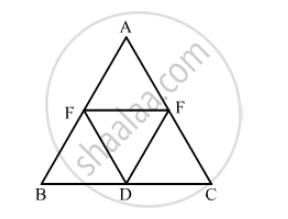
In the following figure, BDEF and DCEF are each a parallelogram. Is it true that BD = DC? Why or why not?
Which of the following statement is true for a rectangle?
Its diagonals are equal and perpendicular, and bisect each other.
A window frame has one diagonal longer than the other. Is the window frame a rectangle? Why or why not?
Prove that quadrilateral formed by the intersection of angle bisectors of all angles of a parallelogram is a rectangle.

State with reason whether the following statement is ‘true’ or ‘false’.
Every parallelogram is a rectangle.
ABCD is a rectangle whose diagonals AC and BD intersect at O. If ∠OAB = 46°, find ∠OBC
Show that the bisectors of angles of a parallelogram form a rectangle
All squares are rectangles.
A line l is parallel to line m and a transversal p intersects them at X, Y respectively. Bisectors of interior angles at X and Y interesct at P and Q. Is PXQY a rectangle? Given reason.
