Advertisements
Advertisements
प्रश्न
Draw a square whose each side measures 4.8 cm.
Advertisements
उत्तर
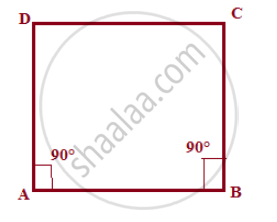
\[\text{ (i) Draw side AB = 4 . 8 cm } . \]
\[\text{ (ii) From A, make an angle of 90°and cut it at 4 . 8 cm and mark it point D } . \]
\[\text{ (iii) From B, make an angle of 90° and cut it at 4 . 8 cm and mark it point C } . \]
\[\text{ (iv) Join C and D } . \]
\[\text{ Thus, ABCD is the required square } .\]
संबंधित प्रश्न
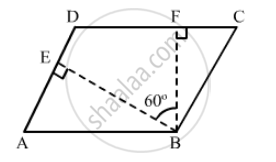
The angle between the altitudes of a parallelogram, through the same vertex of an obtuse angle of the parallelogram is 60°. Find the angles of the parallelogram.
Which of the following statement is true for a rectangle?
It has two pairs of equal sides.
Which of the following statement is true for a rectangle?
Its diagonals bisect each other.
Which of the following statement is true for a rectangle?
Its diagonals are perpendicular and bisect each other.
Using opposite angles test for parallelogram, prove that every rectangle is a parallelogram.
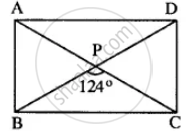
ABCD is a rectangle, if ∠BPC = 124°
Calculate:
- ∠BAP
- ∠ADP
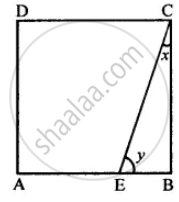
The following figure is a rectangle in which x: y = 3: 7; find the values of x and y.
For which of the following figures, all angles are equal?
Rectangle is a regular quadrilateral.
If diagonals of a quadrilateral are equal, it must be a rectangle.
