Advertisements
Advertisements
प्रश्न
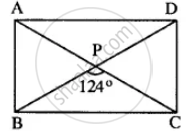
ABCD is a rectangle, if ∠BPC = 124°
Calculate:
- ∠BAP
- ∠ADP
Advertisements
उत्तर
Diagonals of rectangle are equal and bisect each other.
∠PBC = ∠PCB = x (say)
But ∠BPC + ∠PBC + ∠PCB = 180°
124° + x + x = 180°
2x = 180° – 124°
2x = 56°
⇒ x = 28°
∠PBC = 28°
But ∠PBC = ∠ADP [Alternate ∠s]
∠ADP = 28°
Again ∠APB = 180° – 124°
∠APB = 56°
Also, PA = PB
∠BAP = 12 (180° – ∠APB)
= 12 × (180°- 56°)
= 12 × 124°
= 62°
Hence, (i) ∠BAP = 62° (ii) ∠ADP = 28°
APPEARS IN
संबंधित प्रश्न
Two adjacent angles of a parallelogram are (3x − 4)° and (3x + 10)°. Find the angles of the parallelogram.
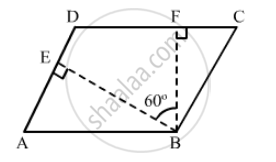
The angle between the altitudes of a parallelogram, through the same vertex of an obtuse angle of the parallelogram is 60°. Find the angles of the parallelogram.
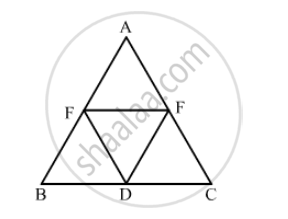
In the following figure, BDEF and DCEF are each a parallelogram. Is it true that BD = DC? Why or why not?
Which of the following statement true for a square?
Its diagonals bisect each other at right angle.
For which of the following figures, all angles are equal?
For which of the following figures, diagonals are equal?
If the adjacent angles of a parallelogram are equal, then the parallelogram is a ______.
PQRS is a rectangle. The perpendicular ST from S on PR divides ∠S in the ratio 2:3. Find ∠TPQ.
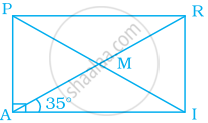
In rectangle PAIR, find ∠ARI, ∠RMI and ∠PMA.
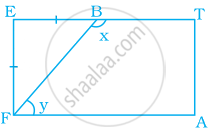
A playground is in the form of a rectangle ATEF. Two players are standing at the points F and B where EF = EB. Find the values of x and y.