Advertisements
Advertisements
प्रश्न
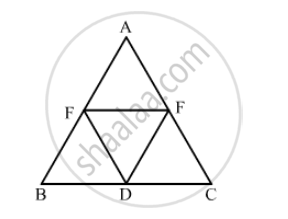
In the following figure, BDEF and DCEF are each a parallelogram. Is it true that BD = DC? Why or why not?
Advertisements
उत्तर
\[\text{ In parallelogram BDEF }\]
\[ \therefore BD = EF . . . (i) (\text{ opposite sides of a parallelogram are equal })\]
\[\text{ In parallelogram DCEF }\]
\[ CD = EF . . . (ii) (\text{ opposite sides of a parallelogram are equal })\]
\[\text{ From equations (i) and } (ii)\]
\[BD = CD\]
संबंधित प्रश्न
Which of the following statement true for a square?
Its diagonals bisect each other at right angle.
Which of the following statement true for a square?
Its diagonals are equal to its sides.
Find the length of the diagonal of a rectangle whose sides are 12 cm and 5 cm.
State with reason whether the following statement is ‘true’ or ‘false’.
Every parallelogram is a rectangle.
Adjacent sides of a rectangle are 7 cm and 24 cm. Find the length of its diagonal.
Diagonals of a rectangle PQRS are intersecting in point M. If ∠QMR = 50° find the measure of ∠MPS.
A parallelogram PQRS is constructed with sides QR = 6 cm, PQ = 4 cm and ∠PQR = 90°. Then PQRS is a ______.
Rectangle is a regular quadrilateral.
In a rectangle ABCD, AB = 25 cm and BC = 15. In what ratio does the bisector of ∠C divide AB?
A rectangular MORE is shown below:

Answer the following questions by giving appropriate reason.
- Is RE = OM?
- Is ∠MYO = ∠RXE?
- Is ∠MOY = ∠REX?
- Is ΔMYO ≅ ΔRXE?
- Is MY = RX?
