Advertisements
Advertisements
Question
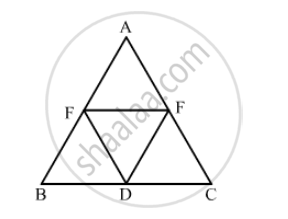
In the following figure, BDEF and DCEF are each a parallelogram. Is it true that BD = DC? Why or why not?
Advertisements
Solution
\[\text{ In parallelogram BDEF }\]
\[ \therefore BD = EF . . . (i) (\text{ opposite sides of a parallelogram are equal })\]
\[\text{ In parallelogram DCEF }\]
\[ CD = EF . . . (ii) (\text{ opposite sides of a parallelogram are equal })\]
\[\text{ From equations (i) and } (ii)\]
\[BD = CD\]
RELATED QUESTIONS
Name the quadrilaterals whose diagonals are equal
Explain why a rectangle is a convex quadrilateral.
In a parallelogram ABCD, the diagonals bisect each other at O. If ∠ABC = 30°, ∠BDC = 10° and ∠CAB = 70°. Find:
∠DAB, ∠ADC, ∠BCD, ∠AOD, ∠DOC, ∠BOC, ∠AOB, ∠ACD, ∠CAB, ∠ADB, ∠ACB, ∠DBC and ∠DBA.
Which of the following statement true for a square?
Its diagonals bisect each other at right angle.
Draw a square whose each side measures 4.8 cm.
If diagonal of a rectangle is 26 cm and one side is 24 cm, find the other side.
ABCD is a rectangle whose diagonals AC and BD intersect at O. If ∠OAB = 46°, find ∠OBC
Show that the bisectors of angles of a parallelogram form a rectangle
A parallelogram PQRS is constructed with sides QR = 6 cm, PQ = 4 cm and ∠PQR = 90°. Then PQRS is a ______.
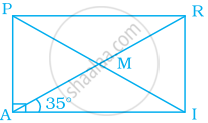
In rectangle PAIR, find ∠ARI, ∠RMI and ∠PMA.