Advertisements
Advertisements
Question
Diagonals of a rectangle PQRS are intersecting in point M. If ∠QMR = 50° find the measure of ∠MPS.
Advertisements
Solution

`square`PQRS is a rectangle.
∴ PM = `1/2` PR …(i)
MS = `1/2` QS …(ii) ...(Diagonals of a rectangle bisect each other)
Also, PR = QS …(iii) ...(Diagonals of a rectangle are congruent)
∴ PM = MS …(iv) ...[From (i), (ii) and (iii)]
In ∆PMS,
PM = MS ...[From (iv)]
∴ ∠MSP = ∠MPS = x° ...(v) ...(Isosceles triangle theorem)
∠PMS = ∠QMR = 50° ...(vi) ...(Vertically opposite angles)
In ∆MPS,
∠PMS + ∠MPS + ∠MSP = 180° ...(The sum of the measures of the three angles of a triangle is 180°.)
∴ 50° + x + x = 180° ...[From (v) and (vi)]
∴ 50° + 2x = 180°
∴ 2x = 180° - 50°
∴ 2x = 130°
∴ x = `(130°)/2`
∴ x = 65°
∴ ∠MPS = 65° ...[From (v)]
APPEARS IN
RELATED QUESTIONS
Two adjacent angles of a parallelogram are (3x − 4)° and (3x + 10)°. Find the angles of the parallelogram.
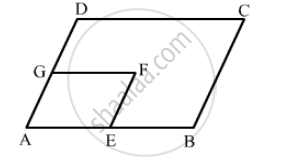
In the following figure, ABCD and AEFG are parallelograms. If ∠C = 55°, what is the measure of ∠F?
Diagonals of a parallelogram ABCD intersect at O. AL and CM are drawn perpendiculars to BD such that L and M lie on BD. Is AL = CM? Why or why not?
Which of the following statement are true for a square?
It has all its sides of equal length.
The sides of a rectangle are in the ratio 4 : 5. Find its sides if the perimeter is 90 cm.
Using opposite angles test for parallelogram, prove that every rectangle is a parallelogram.
Diagonals of a rectangle ABCD intersect at point O. If AC = 8 cm then find BO and if ∠CAD =35° then find ∠ACB.
State with Reason Whether the Following Statement is ‘True’ Or ‘False’.
Every rectangle is a parallelogram.
State with reason whether the following statement is ‘true’ or ‘false’.
Every parallelogram is a rectangle.
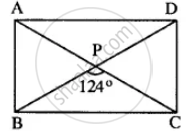
ABCD is a rectangle, if ∠BPC = 124°
Calculate:
- ∠BAP
- ∠ADP
If the diagonals of a parallelogram are of equal lengths, the parallelogram is a rectangle. Prove it.
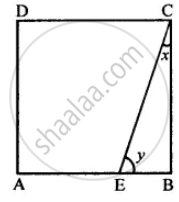
The following figure is a rectangle in which x: y = 3: 7; find the values of x and y.
For which of the following figures, all angles are equal?
All squares are rectangles.
Every trapezium is a rectangle.
A rectangular MORE is shown below:

Answer the following questions by giving appropriate reason.
- Is RE = OM?
- Is ∠MYO = ∠RXE?
- Is ∠MOY = ∠REX?
- Is ΔMYO ≅ ΔRXE?
- Is MY = RX?
A line l is parallel to line m and a transversal p intersects them at X, Y respectively. Bisectors of interior angles at X and Y interesct at P and Q. Is PXQY a rectangle? Given reason.
