Advertisements
Advertisements
Question
Using opposite angles test for parallelogram, prove that every rectangle is a parallelogram.
Advertisements
Solution

Given: `square`ABCD is a rectangle.
To prove: `square`ABCD is a parallelogram.
Proof:
`square`ABCD is a rectangle.
∠A = ∠B = ∠C = ∠D = 90° ...(angles of rectangle)
∠A = ∠B = ∠C = ∠D ...(each angle 90°)
A quadrilateral is a parallelogram if its pairs of opposite angles are congruent.
∴ `square`ABCD is a parallelogram.
APPEARS IN
RELATED QUESTIONS
Two adjacent angles of a parallelogram are (3x − 4)° and (3x + 10)°. Find the angles of the parallelogram.
In a parallelogram ABCD, the diagonals bisect each other at O. If ∠ABC = 30°, ∠BDC = 10° and ∠CAB = 70°. Find:
∠DAB, ∠ADC, ∠BCD, ∠AOD, ∠DOC, ∠BOC, ∠AOB, ∠ACD, ∠CAB, ∠ADB, ∠ACB, ∠DBC and ∠DBA.
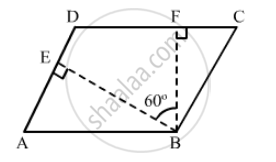
The angle between the altitudes of a parallelogram, through the same vertex of an obtuse angle of the parallelogram is 60°. Find the angles of the parallelogram.
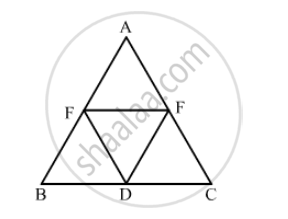
In the following figure, BDEF and DCEF are each a parallelogram. Is it true that BD = DC? Why or why not?
Which of the following statement are true for a square?
It has all its sides of equal length.
Which of the following statement true for a square?
Its diagonals are equal to its sides.
A window frame has one diagonal longer than the other. Is the window frame a rectangle? Why or why not?
The sides of a rectangle are in the ratio 2 : 3, and its perimeter is 20 cm. Draw the rectangle.
The sides of a rectangle are in the ratio 4 : 5. Find its sides if the perimeter is 90 cm.
Draw a rectangle whose one side measures 8 cm and the length of each of whose diagonals is 10 cm.
A mason has made a concrete slab. He needs it to be rectangular. In what different ways can he make sure that it is rectangular?
Diagonals of a rectangle ABCD intersect at point O. If AC = 8 cm then find BO and if ∠CAD =35° then find ∠ACB.
Adjacent sides of a rectangle are 7 cm and 24 cm. Find the length of its diagonal.
Diagonals of a rectangle PQRS are intersecting in point M. If ∠QMR = 50° find the measure of ∠MPS.
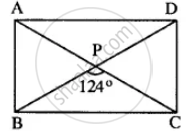
ABCD is a rectangle, if ∠BPC = 124°
Calculate:
- ∠BAP
- ∠ADP
Every parallelogram is a rectangle.
Every trapezium is a rectangle.
In rectangle READ, find ∠EAR, ∠RAD and ∠ROD

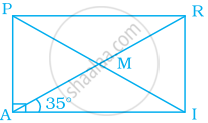
In rectangle PAIR, find ∠ARI, ∠RMI and ∠PMA.
Construct a rectangle whose one side is 3 cm and a diagonal equal to 5 cm.
