Advertisements
Advertisements
Question
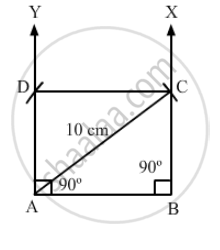
Draw a rectangle whose one side measures 8 cm and the length of each of whose diagonals is 10 cm.
Advertisements
Solution
(i) Draw a side AB, equal to 8 cm.
(ii) With A as the centre, draw an arc of length 10 cm.
(iii) Draw\[\angle\]ABX = 90° which intersects the arc at C.
(iv)Draw\[\angle\]= 90° .
(v) With C as the centre, draw an arc of length 8 cm.
(vi) Join CD.
Thus, ABCD is the required rectangle.
RELATED QUESTIONS
Explain why a rectangle is a convex quadrilateral.
In Fig. 17.29, suppose it is known that DE = DF. Then, is ΔABC isosceles? Why or why not?
Which of the following statement is true for a rectangle?
Its diagonals bisect each other.
Which of the following statement is true for a square?
It is a rectangle.
A window frame has one diagonal longer than the other. Is the window frame a rectangle? Why or why not?
State with Reason Whether the Following Statement is ‘True’ Or ‘False’.
Every rectangle is a parallelogram.
If the diagonals of a parallelogram are of equal lengths, the parallelogram is a rectangle. Prove it.
ABCD is a rectangle whose diagonals AC and BD intersect at O. If ∠OAB = 46°, find ∠OBC
All squares are rectangles.
Quadrilateral EFGH is a rectangle in which J is the point of intersection of the diagonals. Find the value of x if JF = 8x + 4 and EG = 24x – 8.
