Advertisements
Advertisements
Question
Diagonals of a parallelogram ABCD intersect at O. AL and CM are drawn perpendiculars to BD such that L and M lie on BD. Is AL = CM? Why or why not?
Advertisements
Solution

\[\text{ In } \Delta AOL \text{ and } \Delta CMO: \]
\[\angle AOL = \angle COM( \text{ vertically opposite angle }) . . . . (i)\]
\[\angle ALO = \angle CMO = 90° (\text{ each right angle }) . . . . . (ii)\]
\[\text{ Using angle sum property }: \]
\[\angle AOL + \angle ALO + \angle LAO = 180° . . . . . . . . . . (iii)\]
\[\angle COM + \angle CMO + \angle OCM = 180°. . . . . . (iv)\]
\[\text{ From equations } (iii) \text{ and } (iv): \]
\[\angle AOL + \angle ALO + \angle LAO = \angle COM + \angle CMO + \angle OCM\]
\[\angle LAO = \angle OCM (\text{ from equations (i) and } (ii) )\]
\[In \Delta AOL \text{ and }\Delta CMO: \]
\[\angle ALO = \angle CMO (\text{ each right angle })\]
\[AO = OC (\text{ diagonals of a parallelogram bisect each other })\]
\[\angle LAO = \angle OCM (\text{ proved above })\]
\[\text{ So }, \Delta AOL \text{ is congruent to } \Delta CMO (SAS) . \]
\[ \Rightarrow AL = CM [cpct]\]
RELATED QUESTIONS
Explain why a rectangle is a convex quadrilateral.
ABC is a right-angled triangle and O is the mid point of the side opposite to the right angle. Explain why O is equidistant from A, B and C. (The dotted lines are drawn additionally to help you)
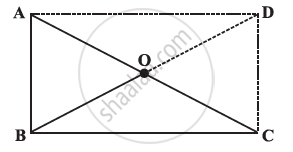
In a rectangle ABCD, prove that ∆ACB ≅ ∆CAD.
Draw a square whose each side measures 4.8 cm.
State with Reason Whether the Following Statement is ‘True’ Or ‘False’.
Every rectangle is a parallelogram.
Adjacent sides of a rectangle are 7 cm and 24 cm. Find the length of its diagonal.
Diagonals of a rectangle PQRS are intersecting in point M. If ∠QMR = 50° find the measure of ∠MPS.
If the adjacent angles of a parallelogram are equal, then the parallelogram is a ______.
A parallelogram PQRS is constructed with sides QR = 6 cm, PQ = 4 cm and ∠PQR = 90°. Then PQRS is a ______.
Construct a rectangle whose one side is 3 cm and a diagonal equal to 5 cm.
