Advertisements
Advertisements
Question
Points E and F lie on diagonal AC of a parallelogram ABCD such that AE = CF. What type of quadrilateral is BFDE?
Advertisements
Solution
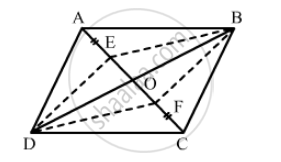
\[AO = OC . . . . . . (i) (\text{ diagonals of a parallelogram bisect each other })\]
\[AE = CF . . . . . . . (ii) (\text{ given })\]
\[\text{ Subtracting (ii) from } (i): \]
\[AO - AE = OC - CF\]
\[EO = OF . . . . . . . . . (iii)\]
\[\text{ In } ∆ DOE \text{ and } ∆ BOF: \]
\[EO = OF (\text{ proved above })\]
\[DO = OB (\text{ diagonals of a parallelogram bisect each other })\]
\[\angle DOE = \angle BOF (\text{ vertically opposite angles })\]
\[\text{ By SAS congruence }: \]
\[ ∆ DOE \cong ∆ BOF\]
\[ \therefore DE = BF (c . p . c . t)\]
\[\text{ In } ∆ BOE \text{ and } ∆ DOF: \]
\[EO = OF (\text{ proved above })\]
\[DO = OB (\text{ diagonals of a parallelogram bisect each other })\]
\[\angle DOF = \angle BOE (\text{ vertically opposite angles })\]
\[\text{ By SAS congruence }: \]
\[ ∆ DOE \cong ∆ BOF\]
\[ \therefore DF = BE (c . p . c . t)\]
\[\text{ Hence, the pair of opposite sides are equal . Thus, DEBF is a parallelogram }. \]
RELATED QUESTIONS
Two adjacent angles of a parallelogram are as 1 : 2. Find the measures of all the angles of the parallelogram.
The perimeter of a parallelogram is 150 cm. One of its sides is greater than the other by 25 cm. Find the length of the sides of the parallelogram.
Which of the following statement is true for a rhombus?
It is a parallelogram.
The diagonals of a parallelogram are not perpendicular. Is it a rhombus? Why or why not?
ABCD is a rhombus. If ∠ACB = 40°, find ∠ADB.
One side of a rhombus is of length 4 cm and the length of an altitude is 3.2 cm. Draw the rhombus.
Show that each diagonal of a rhombus bisects the angle through which it passes.
Diagonals of a rhombus are 20 cm and 21 cm respectively, then find the side of rhombus and its perimeter.
State with reason whether the following statement is ‘true’ or ‘false’.
Every rhombus is a rectangle.
If the adjacent sides of a parallelogram are equal then parallelogram is a ______.
