Advertisements
Advertisements
Question
Which of the following statement is true for a rhombus?
It can be a square.
Advertisements
Solution
True
It can be a square if each of the angle is a right angle.
RELATED QUESTIONS
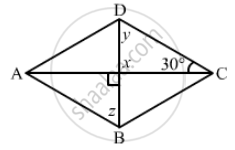
The following figure is parallelogram. Find the degree values of the unknown x, y, z.
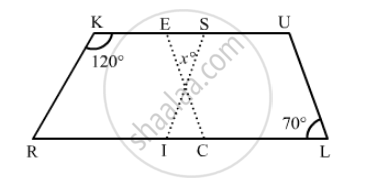
In the following figure RISK and CLUE are parallelograms. Find the measure of x.
Points E and F lie on diagonal AC of a parallelogram ABCD such that AE = CF. What type of quadrilateral is BFDE?
In a parallelogram ABCD, AB = 10 cm, AD = 6 cm. The bisector of ∠A meets DC in E, AEand BC produced meet at F. Find te length CF.
Which of the following statement is true for a rhombus?
It is a parallelogram.
Show that each diagonal of a rhombus bisects the angle through which it passes.
Identify all the quadrilateral that have Four sides of equal length
State with reason whether the following statement is ‘true’ or ‘false’.
Every parallelogram is a rhombus.
All rhombuses are squares.
ABCD is a rhombus such that the perpendicular bisector of AB passes through D. Find the angles of the rhombus.
Hint: Join BD. Then ∆ABD is equilateral.
