Advertisements
Advertisements
Question
ABCD is a rhombus such that the perpendicular bisector of AB passes through D. Find the angles of the rhombus.
Hint: Join BD. Then ∆ABD is equilateral.
Advertisements
Solution
Let ABCD be a rhombus where DE is perpendicular bisector of AB.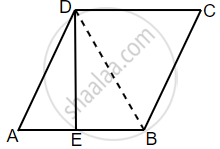
Construction: Join BD.
Now, in triangle AED and triangle BED:
AE = EB
ED = ED ...[Common side]
∠AED = ∠DEB = 90°
Now, using SAS rule,
ΔAED ≅ ΔBED
AD = DB = AB ...[ABCD is a rhombus. So, AD = AB]
Hence, triangle ADB is an equilateral triangle.
So, ∠DAB = ∠DBA = ∠ADB = 60°
∴ ∠DCB = 60° ...[Opposite angles of a rhombus are equal]
Now, ∠DAB + ∠ABC = 180° ...[Adjacent angles of a rhombus are supplementary]
⇒ 60° + ∠ABD + ∠DBC = 180°
⇒ 60° + 60° + ∠DBC = 180°
⇒ ∠DBC = 60°
⇒ ∠ABC = ∠ABD + ∠DBC = 60° + 60° = 120°
∴ ∠ADC = 120° ...[Opposite angles of a rhombus are equal]
Hence, the angles of the rhombus are 60°, 120°, 60°, 120°.
APPEARS IN
RELATED QUESTIONS
In the adjacent figure HOPE is a parallelogram. Find the angle measures x,y and z. State the geometrical truths you use to find them.
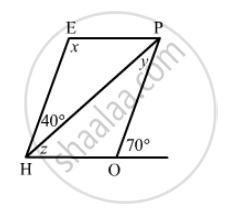
Two opposite angles of a parallelogram are (3x − 2)° and (50 − x)°. Find the measure of each angle of the parallelogram.
In a parallelogram ABCD, ∠D = 135°, determine the measure of ∠A and ∠B.
Two adjacent sides of a parallelogram are 4 cm and 3 cm respectively. Find its perimeter.
Diagonals of parallelogram ABCD intersect at O as shown in the following fegure. XY contains O, and X, Y are points on opposite sides of the parallelogram. Give reasons for each of the following:
(i) OB = OD
(ii) ∠OBY = ∠ODX
(iii) ∠BOY = ∠DOX
(iv) ∆BOY ≅ ∆DOX
Now, state if XY is bisected at O.
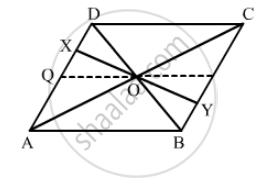
Which of the following statement is true for a rhombus?
It has two pairs of equal sides.
State with reason whether the following statement is ‘true’ or ‘false’.
Every rhombus is a rectangle.
Lengths of diagonals of a rhombus ABCD are 16 cm and 12 cm. Find the side and perimeter of the rhombus.
A quadrilateral whose all sides are equal, opposite angles are equal and the diagonals bisect each other at right angles is a ______.
Diagonals of a quadrilateral are perpendicular to each other. Is such a quadrilateral always a rhombus? Give a figure to justify your answer.
