Advertisements
Advertisements
Question
If all sides of a quadrilateral are equal, it is a ______.
Advertisements
Solution
If all sides of a quadrilateral are equal, it is a rhombus.
Explanation:
Rhombus is a quadrilateral whose all sides are equal.
APPEARS IN
RELATED QUESTIONS
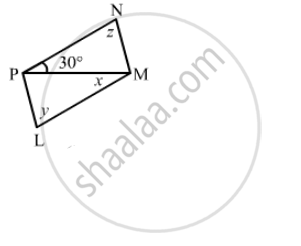
The following figure is parallelogram. Find the degree values of the unknown x, y, z.
Two adjacent angles of a parallelogram are as 1 : 2. Find the measures of all the angles of the parallelogram.
In a parallelogram ABCD, ∠D = 135°, determine the measure of ∠A and ∠B.
Two adjacent sides of a parallelogram are 4 cm and 3 cm respectively. Find its perimeter.
Which of the following statement is true for a rhombus?
Two of its angles are at right angles
Which of the following statement is true for a rhombus?
It is a square.
Construct a rhombus whose diagonals are of length 10 cm and 6 cm.
State with reason whether the following statement is ‘true’ or ‘false’.
Every rhombus is a rectangle.
Diagonals PR and QS of a rhombus PQRS are 20 cm and 48 cm respectively. Find the length of side PQ.
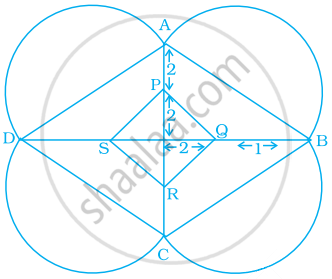
A Rangoli has been drawn on a flor of a house. ABCD and PQRS both are in the shape of a rhombus. Find the radius of semicircle drawn on each side of rhombus ABCD.