Advertisements
Advertisements
Question
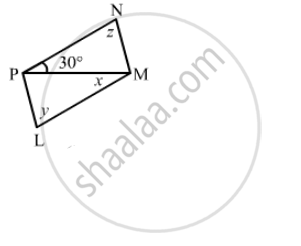
The following figure is parallelogram. Find the degree values of the unknown x, y, z.
Advertisements
Solution
\[\text{ Sum of all angles in a triangle is } {180}^° . \]
\[ \therefore 30° + 90° + z = 180°\]
\[z = 60°\]
\[\text{ Opposite angles are equal in parallelogram } . \]
\[ \therefore y = z = 60°\]
\[\text{ and } x = 30° (\text{ alternate angles })\]
RELATED QUESTIONS
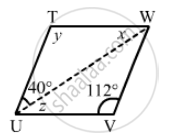
The following figure is parallelogram. Find the degree value of the unknown x, y, z.
Which of the following statement is true for a rhombus?
It is a square.
Draw a rhombus, having each side of length 3.5 cm and one of the angles as 40°.
ABCD is a rhombus and its diagonals intersect at O.
(i) Is ∆BOC ≅ ∆DOC? State the congruence condition used?
(ii) Also state, if ∠BCO = ∠DCO.
If opposite angles of a rhombus are (2x)° and (3x - 40)° then value of x is ______.
Lengths of diagonals of a rhombus ABCD are 16 cm and 12 cm. Find the side and perimeter of the rhombus.
In rhombus ABCD;
(i) if ∠A = 74° ; find ∠B and ∠C.
(ii) if AD = 7.5 cm ; find BC and CD.
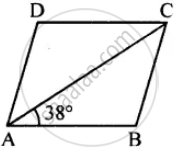
ABCD is a rhombus. If ∠BAC = 38°, find :
(i) ∠ACB
(ii) ∠DAC
(iii) ∠ADC.
ABCD is a rhombus. If ∠BCA = 35°. find ∠ADC.
A rhombus is a parallelogram in which ______ sides are equal.
