Advertisements
Advertisements
Question
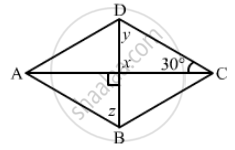
The following figure is parallelogram. Find the degree values of the unknown x, y, z.
Advertisements
Solution
\[ x = 90° (\text{ vertically opposite angle })\]
\[\text{ Sum of all angles in a triangle is } {180}^°. \]
\[ \therefore y + 90°+ 30° = 180°\]
\[y = 180°- (90°+ 30°) = 60°\]
\[y = z = 60° (\text{ alternate angles })\]
RELATED QUESTIONS
Name the quadrilaterals whose diagonals are perpendicular bisectors of each other
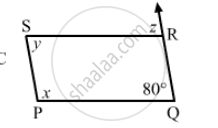
The following figure is parallelogram. Find the degree values of the unknown x, y, z.
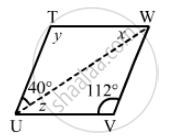
The following figure is parallelogram. Find the degree value of the unknown x, y, z.
All the angles of a quadrilateral are equal to each other. Find the measure of each. Is the quadrilateral a parallelogram? What special type of parallelogram is it?
If the diagonals of a rhombus are 12 cm and 16cm, find the length of each side.
Lengths of diagonals of a rhombus ABCD are 16 cm and 12 cm. Find the side and perimeter of the rhombus.
Measure of one angle of a rhombus is 50°, find the measures of remaining three angles.
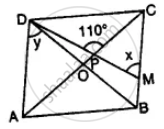
The given figure shows a rhombus ABCD in which angle BCD = 80°. Find angles x and y.
All rhombuses are squares.
ABCD is a rhombus such that the perpendicular bisector of AB passes through D. Find the angles of the rhombus.
Hint: Join BD. Then ∆ABD is equilateral.
