Advertisements
Advertisements
Question
Which of the following statement is true for a rhombus?
It has only two pairs of equal sides.
Advertisements
Solution
True
RELATED QUESTIONS
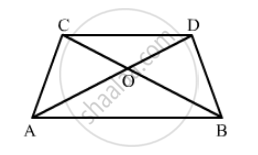
Given below is a parallelogram ABCD. Complete each statement along with the definition or property used.
(i) AD =
(ii) ∠DCB =
(iii) OC =
(iv) ∠DAB + ∠CDA =
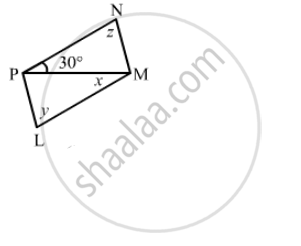
The following figure is parallelogram. Find the degree values of the unknown x, y, z.
Two adjacent sides of a parallelogram are 4 cm and 3 cm respectively. Find its perimeter.
Points E and F lie on diagonal AC of a parallelogram ABCD such that AE = CF. What type of quadrilateral is BFDE?
Which of the following statement is true for a rhombus?
It has two pairs of parallel sides.
Draw a rhombus, having each side of length 3.5 cm and one of the angles as 40°.
Draw a rhombus ABCD, if AB = 6 cm and AC = 5 cm.
If opposite angles of a rhombus are (2x)° and (3x - 40)° then value of x is ______.
If a diagonal of a quadrilateral bisects both the angles, then it is a ______.
Construct a rhombus CLUE in which CL = 7.5 cm and LE = 6 cm.
