Advertisements
Advertisements
प्रश्न
Which of the following statement is true for a rhombus?
It has only two pairs of equal sides.
Advertisements
उत्तर
True
संबंधित प्रश्न
Can the following figure be parallelogram. Justify your answer.
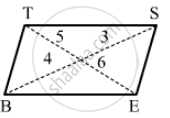
The sum of two opposite angles of a parallelogram is 130°. Find all the angles of the parallelogram.
In a parallelogram ABCD, AB = 10 cm, AD = 6 cm. The bisector of ∠A meets DC in E, AEand BC produced meet at F. Find te length CF.
Which of the following statement is true for a rhombus?
Two of its angles are at right angles
Which of the following statement is true for a rhombus?
It is a parallelogram.
Which of the following statement is true for a rhombus?
It is a quadrilateral.
Fill in the blank, inthe following, so as to make the statement true:
A square is a rhombus in which .....
Construct a rhombus whose diagonals are of length 10 cm and 6 cm.
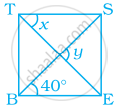
In the figure, BEST is a rhombus, Then the value of y – x is ______.
If a diagonal of a quadrilateral bisects both the angles, then it is a ______.
