Advertisements
Advertisements
प्रश्न
Construct a rhombus whose diagonals are of length 10 cm and 6 cm.
Advertisements
उत्तर
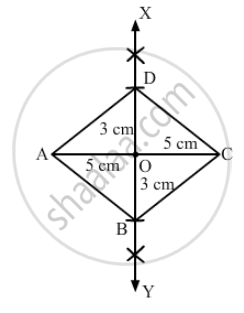
1. Draw AC equal to 10 cm.
2. Draw XY, the right bisector of AC, meeting it at O.
3. With O as centre and radius equal to half of the length of the other diagonal,
i.e. 3 cm, cut OB = OD = 3 cm.
4. Join AB, AD and CB, CD.
संबंधित प्रश्न
Name the quadrilaterals whose diagonals are perpendicular bisectors of each other
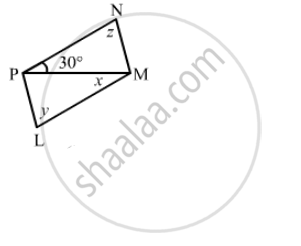
The following figure is parallelogram. Find the degree values of the unknown x, y, z.
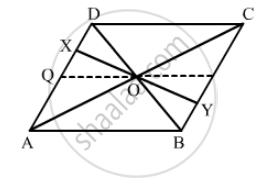
Diagonals of parallelogram ABCD intersect at O as shown in the following fegure. XY contains O, and X, Y are points on opposite sides of the parallelogram. Give reasons for each of the following:
(i) OB = OD
(ii) ∠OBY = ∠ODX
(iii) ∠BOY = ∠DOX
(iv) ∆BOY ≅ ∆DOX
Now, state if XY is bisected at O.
Points E and F lie on diagonal AC of a parallelogram ABCD such that AE = CF. What type of quadrilateral is BFDE?
Which of the following statement is true for a rhombus?
It can be a square.
One side of a rhombus is of length 4 cm and the length of an altitude is 3.2 cm. Draw the rhombus.
In rhombus ABCD;
(i) if ∠A = 74° ; find ∠B and ∠C.
(ii) if AD = 7.5 cm ; find BC and CD.
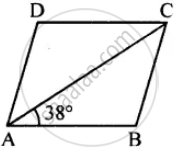
ABCD is a rhombus. If ∠BAC = 38°, find :
(i) ∠ACB
(ii) ∠DAC
(iii) ∠ADC.
In a rhombus diagonals intersect at ______ angles.
Construct a rhombus whose side is 5 cm and one angle is of 60°.
