Advertisements
Advertisements
प्रश्न
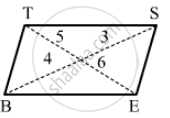
Can the following figure be parallelogram. Justify your answer.
Advertisements
उत्तर
\[\text{ No, This is because the diagonals do not bisect each other } .\]
संबंधित प्रश्न
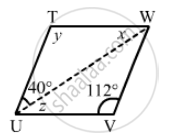
The following figure is parallelogram. Find the degree value of the unknown x, y, z.
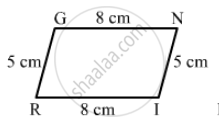
Can the following figure be parallelogram. Justify your answer.
ABCD is a parallelogram in which ∠A = 70°. Compute ∠B, ∠C and ∠D.
Two adjacent sides of a parallelogram are 4 cm and 3 cm respectively. Find its perimeter.
Which of the following statement is true for a rhombus?
It has all its sides of equal lengths.
The diagonals of a parallelogram are not perpendicular. Is it a rhombus? Why or why not?
The diagonals of a quadrilateral are perpendicular to each other. Is such a quadrilateral always a rhombus? If your answer is 'No', draw a figure to justify your answer.
The diagonals of a quadrilateral are of lengths 6 cm and 8 cm. If the diagonals bisect each other at right angles, what is the length of each side of the quadrilateral?
In a rhombus PQRS if PQ = 7.5 cm then find QR. If ∠QPS = 75° then find the measure of ∠PQR and ∠SRQ.
If all sides of a quadrilateral are equal, it is a ______.
