Advertisements
Advertisements
Question
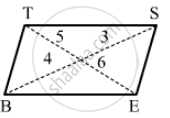
Can the following figure be parallelogram. Justify your answer.
Advertisements
Solution
\[\text{ No, This is because the diagonals do not bisect each other } .\]
RELATED QUESTIONS
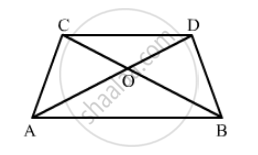
Given below is a parallelogram ABCD. Complete each statement along with the definition or property used.
(i) AD =
(ii) ∠DCB =
(iii) OC =
(iv) ∠DAB + ∠CDA =
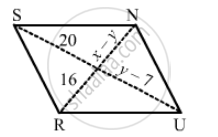
In the following figure GUNS and RUNS are parallelogram. Find x and y.
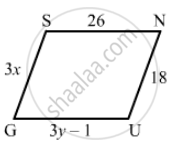
In the following figure GUNS and RUNS are parallelogram. Find x and y.
Two opposite angles of a parallelogram are (3x − 2)° and (50 − x)°. Find the measure of each angle of the parallelogram.
Two adjacent angles of a parallelogram are as 1 : 2. Find the measures of all the angles of the parallelogram.
The sum of two opposite angles of a parallelogram is 130°. Find all the angles of the parallelogram.
In the following Figure ABCD is a arallelogram, CE bisects ∠C and AF bisects ∠A. In each of the following, if the statement is true, give a reason for the same:
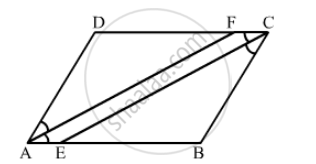
(i) ∠A = ∠C
(ii) \[\angle FAB = \frac{1}{2}\angle A\]
(iii) \[\angle DCE = \frac{1}{2}\angle C\]
(iv) \[\angle CEB = \angle FAB\]
(v) CE || AF
Which of the following statement is true for a rhombus?
It has only two pairs of equal sides.
If the diagonals of a rhombus are 12 cm and 16cm, find the length of each side.
If the adjacent sides of a parallelogram are equal then parallelogram is a ______.
