Advertisements
Advertisements
Question
A quadrilateral whose all sides are equal, opposite angles are equal and the diagonals bisect each other at right angles is a ______.
Options
rhombus
parallelogram
square
rectangle
Advertisements
Solution
A quadrilateral whose all sides are equal, opposite angles are equal and the diagonals bisect each other at right angles is a rhombus.
Explanation:
All sides of a rhombus are equal and the diagonals bisect each other at right angles. It is also applicable for square but it is a superior form of rhombus whose all angles are equal.
APPEARS IN
RELATED QUESTIONS
In the following figure GUNS and RUNS are parallelogram. Find x and y.
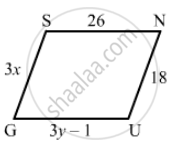
In the following figure GUNS and RUNS are parallelogram. Find x and y.
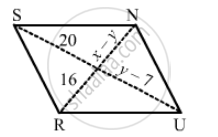
If an angle of a parallelogram is two-third of its adjacent angle, find the angles of the parallelogram.
Two adjacent angles of a parallelogram are as 1 : 2. Find the measures of all the angles of the parallelogram.
Which of the following statement is true for a rhombus?
Its diagonals are equal and perpendicular.
Which of the following statement is true for a rhombus?
It is a parallelogram.
Diagonals of a rhombus are 20 cm and 21 cm respectively, then find the side of rhombus and its perimeter.
Diagonals PR and QS of a rhombus PQRS are 20 cm and 48 cm respectively. Find the length of side PQ.
Draw a rhombus KLMN such that its side is 4 cm and m∠K = 75°.
Diagonals of a quadrilateral are perpendicular to each other. Is such a quadrilateral always a rhombus? Give a figure to justify your answer.
