Advertisements
Advertisements
प्रश्न
A quadrilateral whose all sides are equal, opposite angles are equal and the diagonals bisect each other at right angles is a ______.
पर्याय
rhombus
parallelogram
square
rectangle
Advertisements
उत्तर
A quadrilateral whose all sides are equal, opposite angles are equal and the diagonals bisect each other at right angles is a rhombus.
Explanation:
All sides of a rhombus are equal and the diagonals bisect each other at right angles. It is also applicable for square but it is a superior form of rhombus whose all angles are equal.
APPEARS IN
संबंधित प्रश्न
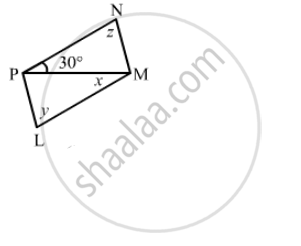
The following figure is parallelogram. Find the degree values of the unknown x, y, z.
The measure of one angle of a parallelogram is 70°. What are the measures of the remaining angles?
ABCD is a parallelogram in which ∠A = 70°. Compute ∠B, ∠C and ∠D.
Which of the following statement is true for a rhombus?
It can be a square.
Fill in the blank, in the following, so as to make the statement true:
A rhombus is a parallelogram in which ......
ABCD is a rhombus and its diagonals intersect at O.
(i) Is ∆BOC ≅ ∆DOC? State the congruence condition used?
(ii) Also state, if ∠BCO = ∠DCO.
Which of the following statement is true for a rectangle?
Its diagonals are equal and bisect each other.
State with reason whether the following statement is ‘true’ or ‘false’.
Every parallelogram is a rhombus.
Lengths of diagonals of a rhombus ABCD are 16 cm and 12 cm. Find the side and perimeter of the rhombus.
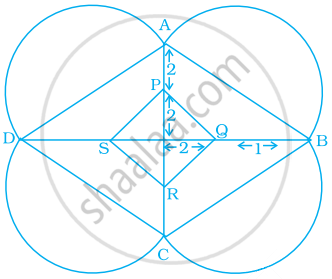
A Rangoli has been drawn on a flor of a house. ABCD and PQRS both are in the shape of a rhombus. Find the radius of semicircle drawn on each side of rhombus ABCD.