Advertisements
Advertisements
प्रश्न
If two adjacent angles of a parallelogram are (5x – 5)° and (10x + 35)°, then the ratio of these angles is ______.
पर्याय
1 : 3
2 : 3
1 : 4
1 : 2
Advertisements
उत्तर
If two adjacent angles of a parallelogram are (5x – 5)° and (10x + 35)°, then the ratio of these angles is 1 : 3.
Explanation:
We know that, adjacent angles of a parallelogram are supplementary, i.e. their sum equals 180°.
∴ (5x – 5) + (10x + 35) = 180°
⇒ 15x + 30° = 180°
⇒ 15x = 150°
⇒ x = 10°
Thus, the angles are (5 × 10 – 5) and (10 × 10 + 35), i.e. 45° and 135°.
Hence, the required ratio is 45° : 135°, i.e. 1 : 3.
APPEARS IN
संबंधित प्रश्न
Consider the given parallelogram. Find the values of the unknowns x, y, z.
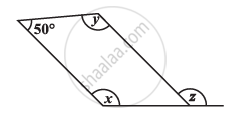
Consider the given parallelograms. Find the values of the unknowns x, y, z.

Can a quadrilateral ABCD be a parallelogram if ∠A = 70° and ∠C = 65°?
Name the quadrilaterals whose diagonals bisect each other
In the given figure, `square`PQRS and `square`ABCR are two parallelograms. If ∠P = 110° then find the measures of all angles of `square`ABCR.

Construct a parallelogram ABCD such that l(BC) = 7 cm, m∠ABC = 40° , l(AB) = 3 cm.
In the following diagram, the bisectors of interior angles of the parallelogram PQRS enclose a quadrilateral ABCD.
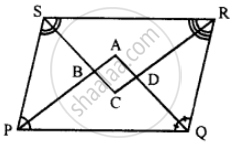
Show that:
(i) ∠PSB + ∠SPB = 90°
(ii) ∠PBS = 90°
(iii) ∠ABC = 90°
(iv) ∠ADC = 90°
(v) ∠A = 90°
(vi) ABCD is a rectangle
Thus, the bisectors of the angles of a parallelogram enclose a rectangle.
In the given figure, AB || EC, AB = AC and AE bisects ∠DAC. Prove that:

- ∠EAC = ∠ACB
- ABCE is a parallelogram.
Which of the following is a property of a parallelogram?
ABCD is a parallelogram. Points P and Q are taken on the sides AB and AD respectively and the parallelogram PRQA is formed. If ∠C = 45°, find ∠R.
