Advertisements
Advertisements
प्रश्न
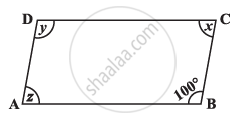
Consider the given parallelogram. Find the values of the unknowns x, y, z.
Advertisements
उत्तर १
x + 100° = 180° (Adjacent angles are supplementary)
x = 80°
z = x = 80º(Opposite angles are equal)
y = 100° (Opposite angles are equal)
उत्तर २
ABCD is a parallelogram in which ∠B = 100° (given)
∴ ∠A + ∠B = 180° ...[∵ Sum of adjacent angles is 180°]
⇒ z + 100° = 180°
⇒ z = 180° − 100° = 80°
Also ∠B = ∠D and ∠A = ∠C ...[∵ Opposite angles are equal]
∴ ∠B = 100° = ∠D = y and ∠A = z = 80° = ∠C = x
∴ x = 80°, y = 100°, z = 80°
संबंधित प्रश्न
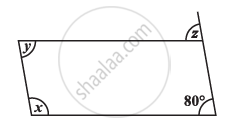
Consider the given parallelograms. Find the values of the unknowns x, y, z.
Two adjacent angles of a parallelogram have equal measure. Find the measure of each of the angles of the parallelogram.
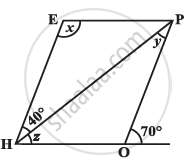
The adjacent figure HOPE is a parallelogram. Find the angle measures x, y and z. State the properties you use to find them.
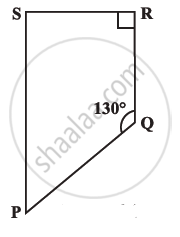
Find the measure of ∠P and ∠S, if `bar(SP) || bar(RQ)` in the following figure. (If you find m∠R, is there more than one method to find m∠P?).
ABCD is a parallelogram. What kind of quadrilateral is it if: AC = BD but AC is not perpendicular to BD?
In the following diagram, the bisectors of interior angles of the parallelogram PQRS enclose a quadrilateral ABCD.
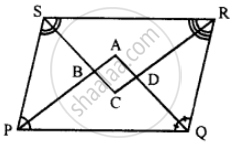
Show that:
(i) ∠PSB + ∠SPB = 90°
(ii) ∠PBS = 90°
(iii) ∠ABC = 90°
(iv) ∠ADC = 90°
(v) ∠A = 90°
(vi) ABCD is a rectangle
Thus, the bisectors of the angles of a parallelogram enclose a rectangle.
In parallelogram ABCD, X and Y are midpoints of opposite sides AB and DC respectively. Prove that:
(i) AX = YC
(ii) AX is parallel to YC
(iii) AXCY is a parallelogram.
The angle between the two altitudes of a parallelogram through the same vertex of an obtuse angle of the parallelogram is 30°. The measure of the obtuse angle is ______.
Two angles of a quadrilateral are each of measure 75° and the other two angles are equal. What is the measure of these two angles? Name the possible figures so formed.
ABCD is a parallelogram. Points P and Q are taken on the sides AB and AD respectively and the parallelogram PRQA is formed. If ∠C = 45°, find ∠R.
