Advertisements
Advertisements
प्रश्न
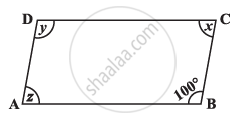
Consider the given parallelogram. Find the values of the unknowns x, y, z.
Advertisements
उत्तर १
x + 100° = 180° (Adjacent angles are supplementary)
x = 80°
z = x = 80º(Opposite angles are equal)
y = 100° (Opposite angles are equal)
उत्तर २
ABCD is a parallelogram in which ∠B = 100° (given)
∴ ∠A + ∠B = 180° ...[∵ Sum of adjacent angles is 180°]
⇒ z + 100° = 180°
⇒ z = 180° − 100° = 80°
Also ∠B = ∠D and ∠A = ∠C ...[∵ Opposite angles are equal]
∴ ∠B = 100° = ∠D = y and ∠A = z = 80° = ∠C = x
∴ x = 80°, y = 100°, z = 80°
संबंधित प्रश्न
Can a quadrilateral ABCD be a parallelogram if AB = DC = 8 cm, AD = 4 cm and BC = 4.4 cm?
Can a quadrilateral ABCD be a parallelogram if ∠A = 70° and ∠C = 65°?
The measures of two adjacent angles of a parallelogram are in the ratio 3 : 2. Find the measure of each of the angles of the parallelogram.
In the given figure, `square`PQRS and `square`ABCR are two parallelograms. If ∠P = 110° then find the measures of all angles of `square`ABCR.

In parallelogram ABCD, E is the mid-point of AD and F is the mid-point of BC. Prove that BFDE is a parallelogram.
In parallelogram ABCD, E is the mid-point of side AB and CE bisects angle BCD. Prove that:
- AE = AD,
- DE bisects and ∠ADC and
- Angle DEC is a right angle.
Iron rods a, b, c, d, e, and f are making a design in a bridge as shown in the figure. If a || b, c || d, e || f, find the marked angles between d and e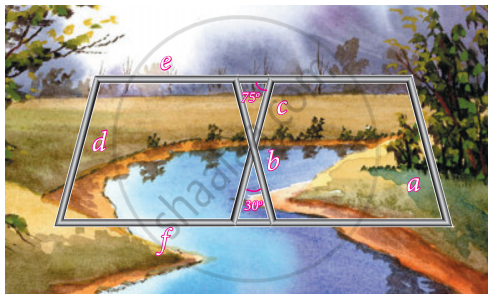
The angle between the two altitudes of a parallelogram through the vertex of an obtuse angle of the parallelogram is 45°. Find the angles of the parallelogram.
Construct a parallelogram HOME with HO = 6 cm, HE = 4 cm and OE = 3 cm.
Construct a parallelogram when one of its side is 4 cm and its two diagonals are 5.6 cm and 7 cm. Measure the other side.
