Advertisements
Advertisements
Question
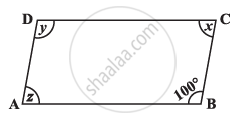
Consider the given parallelogram. Find the values of the unknowns x, y, z.
Advertisements
Solution 1
x + 100° = 180° (Adjacent angles are supplementary)
x = 80°
z = x = 80º(Opposite angles are equal)
y = 100° (Opposite angles are equal)
Solution 2
ABCD is a parallelogram in which ∠B = 100° (given)
∴ ∠A + ∠B = 180° ...[∵ Sum of adjacent angles is 180°]
⇒ z + 100° = 180°
⇒ z = 180° − 100° = 80°
Also ∠B = ∠D and ∠A = ∠C ...[∵ Opposite angles are equal]
∴ ∠B = 100° = ∠D = y and ∠A = z = 80° = ∠C = x
∴ x = 80°, y = 100°, z = 80°
RELATED QUESTIONS
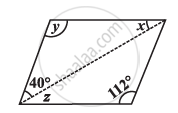
Consider the given parallelograms. Find the values of the unknowns x, y, z.
In the given figure, `square`PQRS and `square`ABCR are two parallelograms. If ∠P = 110° then find the measures of all angles of `square`ABCR.

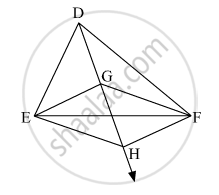
In the given figure, G is the point of concurrence of medians of ΔDEF. Take point H on ray DG such that D-G-H and DG = GH, then prove that `square`GEHF is a parallelogram.
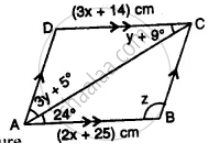
Use the information given in the alongside diagram to find the value of x, y, and z.
The adjacent sides of a parallelogram are 5 cm and 9 cm. Its perimeter is ______.
In parallelogram PQRS, O is the mid point of SQ. Find ∠S, ∠R, PQ, QR and diagonal PR.

In parallelogram MODE, the bisector of ∠M and ∠O meet at Q, find the measure of ∠MQO.
Two angles of a quadrilateral are each of measure 75° and the other two angles are equal. What is the measure of these two angles? Name the possible figures so formed.
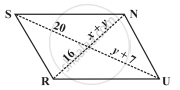
The following figure RUNS is parallelogram. Find x and y. (Lengths are in cm)
Draw a rough figure of a quadrilateral that is not a parallelogram but has exactly two opposite angles of equal measure.
