Advertisements
Advertisements
Question
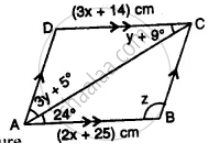
Use the information given in the alongside diagram to find the value of x, y, and z.
Advertisements
Solution
ABCD is a parallelogram and AC is its diagonal which bisects the opposite angle
Opposite sides of a parallelogram are equal
3x + 14 = 2x + 25
⇒ 3x – 2x = 25 – 14
⇒ x = 11
∴ x = 11 cm
∠DCA = ∠CAB (Alternate angles)
y + 9° = 24
y = 24° – 9° = 15°
∠DAB = 3y° + 5° + 24° = 3 x 15 + 5 + 24° = 50° + 24° = 74°
∠ABC =180°- ∠DAB = 180° – 74° = 106°
z = 106°
Hence x = 11 cm, y = 15°, z = 106°
APPEARS IN
RELATED QUESTIONS
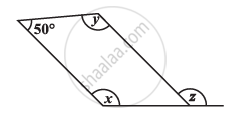
Consider the given parallelogram. Find the values of the unknowns x, y, z.
Can a quadrilateral ABCD be a parallelogram if ∠D + ∠B = 180°?
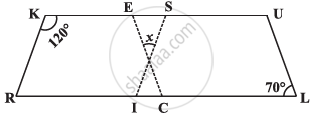
In the above figure both RISK and CLUE are parallelograms. Find the value of x.
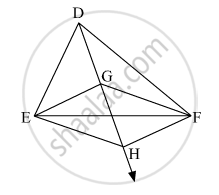
In the given figure, G is the point of concurrence of medians of ΔDEF. Take point H on ray DG such that D-G-H and DG = GH, then prove that `square`GEHF is a parallelogram.
PQRS is a parallelogram whose diagonals intersect at M.
If ∠PMS = 54°, ∠QSR = 25° and ∠SQR = 30° ; find :
(i) ∠RPS
(ii) ∠PRS
(iii) ∠PSR.
Which of the following figures satisfy the following properties?
- All sides are congruent.
- All angles are right angles.
- Opposite sides are parallel.
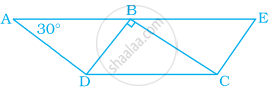
In the given figure, ABCD and BDCE are parallelograms with common base DC. If BC ⊥ BD, then ∠BEC = ______.
All rectangles are parallelograms.
If opposite angles of a quadrilateral are equal, it must be a parallelogram.
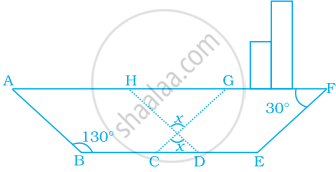
In the following figure of a ship, ABDH and CEFG are two parallelograms. Find the value of x.