Advertisements
Advertisements
Question
Construct ☐ PQRS, such that l(PQ) = 3.5 cm, l(QR) = 5.6 cm, l(RS) = 3.5 cm, m∠Q = 110°, m∠R = 70°. If it is given that ☐ PQRS is a parallelogram, which of the given information is unnecessary?
Advertisements
Solution
Steps of Construction:
Step 1: Draw PQ = 3.5 cm.
Step 2: Draw ∠PQX = 110°.
Step 3: With Q as the center and a radius of 5.6 cm, draw an arc-cutting ray QX at R.
Step 4: Draw ∠QRY = 70°.
Step 5: With R as centre and radius 3.5 cm, draw an arc cutting ray RY at S.
Step 6: Join PS.
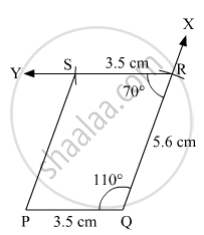
Here, PQRS is the required quadrilateral.
If it is given that quadrilateral PQRS is a parallelogram, then the information l(RS) = 3.5 cm and m∠R = 70° is unnecessary.
RELATED QUESTIONS
The measures of two adjacent angles of a parallelogram are in the ratio 3 : 2. Find the measure of each of the angles of the parallelogram.
Two adjacent angles of a parallelogram have equal measure. Find the measure of each of the angles of the parallelogram.
Perimeter of a parallelogram is 150 cm. One of its sides is greater than the other side by 25 cm. Find the lengths of all sides.
If the ratio of measures of two adjacent angles of a parallelogram is 1 : 2, find the measures of all angles of the parallelogram.
Ratio of two adjacent sides of a parallelogram is 3 : 4, and its perimeter is 112 cm. Find the length of its each side.
Ratio of consecutive angles of a quadrilateral is 1 : 2 : 3 : 4. Find the measure of its each angle. Write, with reason, what type of a quadrilateral it is.
ABCD is a parallelogram. What kind of quadrilateral is it if: AC = BD but AC is not perpendicular to BD?
In parallelogram ABCD, X and Y are midpoints of opposite sides AB and DC respectively. Prove that:
(i) AX = YC
(ii) AX is parallel to YC
(iii) AXCY is a parallelogram.
The angle between the two altitudes of a parallelogram through the same vertex of an obtuse angle of the parallelogram is 30°. The measure of the obtuse angle is ______.
A diagonal of a parallelogram bisects an angle. Will it also bisect the other angle? Give reason.
